Origin and composition of the Siderolithic Group, Geneva Basin (GEo-02 well)
DOI:
https://doi.org/10.57035/journals/sdk.2026.e41.1914Keywords:
Karst, K-Pg, Middle Eocene Climatic Optimum MECO, Geneva Basin, SiderolithicAbstract
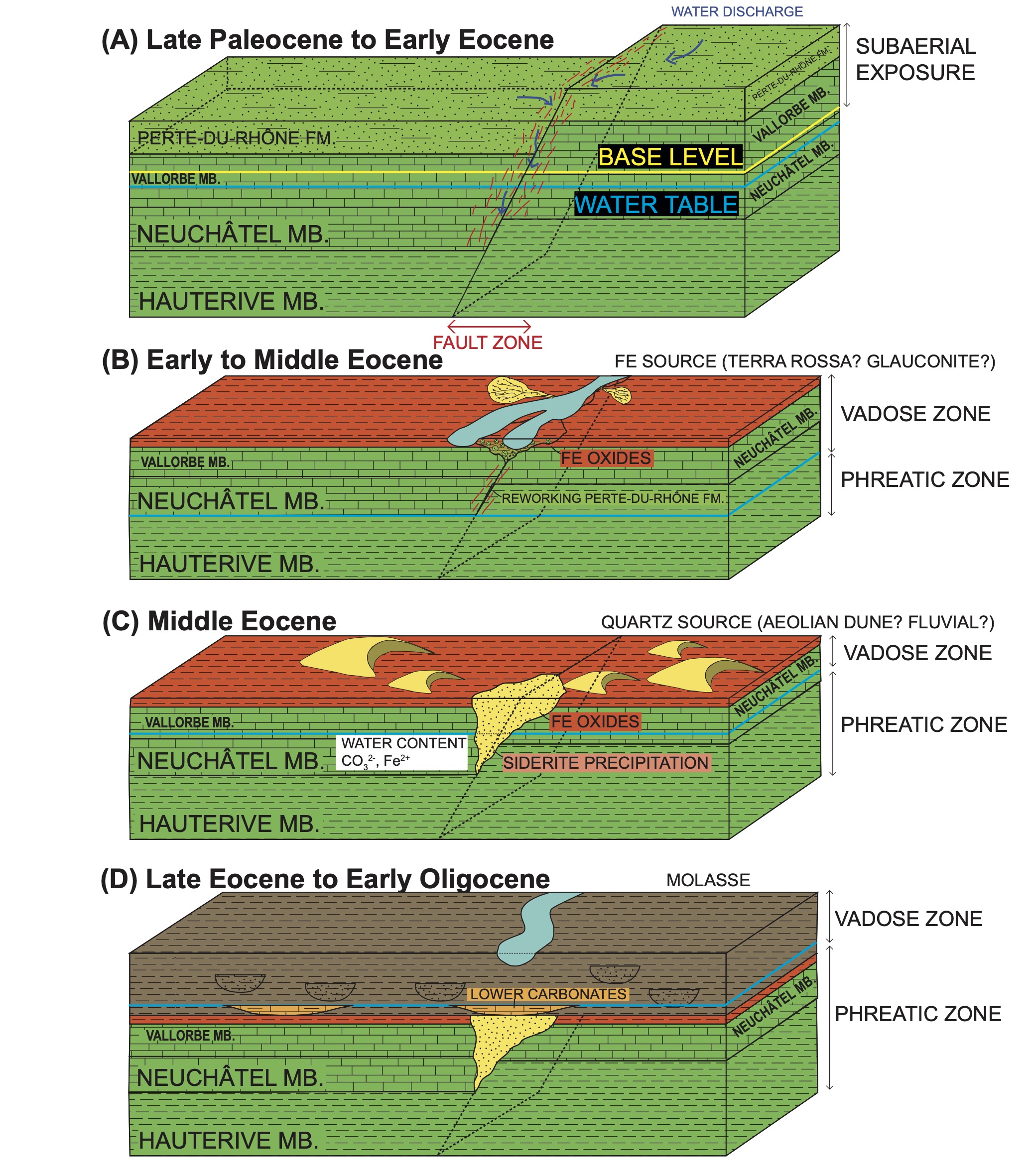
This study provides new insights into the Siderolithic Group, a 158 m -thick sedimentary succession deposited within a regionally extensive karstified unconformity spanning tens of square kilometres. This unconformity marks the Cretaceous-Paleogene boundary, with a stratigraphic gap of about 94 Myr, ranging from the Lower Cretaceous (Barremian–Aptian) to (likely) the Bartonian (Eocene). Using borehole data from the GEo-02 geothermal exploration well in the Geneva Basin, our study integrates petrography, mineralogy, geochemistry, and petrophysical analyses of 139 samples to reconstruct the evolution of this complex depositional system. Six sedimentological subunits were identified, representing distinct phases of karst evolution, from initial formation to infill and subsequent diagenesis. Variations in gamma ray values suggest fluctuating water levels within the karst system, while the heterogeneous distribution of quartz grains indicates detrital sediment input from both aeolian and fluvial sources. The mineral assemblage, dominated by siderite, chlorite, and kaolinite, reflects diagenetic processes under reducing conditions, with siderite facilitating kaolinite chloritisation in the presence of quartz. Geochemical data and clay mineral data indicate humid climatic conditions during deposition. The Siderolithic Group is inferred to be of Bartonian age based on biostratigraphic constraints from analogue deposits on the Swiss Plateau, suggesting its deposition during the Middle Eocene Climatic Optimum (MECO). This study provides one of the few continental records of the MECO in Western Europe, recording high mercury content possibly related to the flare-up in Neotethys subduction zone volcanism.
Downloads
References
Agosta, F., Alessandroni, M., Antonellini, M., Tondi, E., & Giorgioni, M. (2010). From fractures to flow: A field-based quantitative analysis of an outcropping carbonate reservoir. Tectonophysics, 490(3–4), 197–213. https://doi.org/10.1016/j.tecto.2010.05.005 DOI: https://doi.org/10.1016/j.tecto.2010.05.005
Allen, P. A., Crampton, S. L., & Sinclair, H. D. (1991). The inception and early evolution of the North Alpine Foreland Basin, Switzerland. Basin Research, 3(3), 143–163. https://doi.org/10.1111/j.1365-2117.1991.tb00124.x DOI: https://doi.org/10.1111/j.1365-2117.1991.tb00124.x
Alonso-Zarza, A. M., & Tanner, L. H. (Eds). (2006). Paleoenvironmental Record and Applications of Calcretes and Palustrine Carbonates. Geological Society of America. https://doi.org/10.1130/spe416 DOI: https://doi.org/10.1130/SPE416
Banfield, J. F., & Eggleton, R. A. (1990). Analytical Transmission Electron Microscope Studies of Plagioclase, Muscovite, and K-Feldspar Weathering. Clays and Clay Minerals, 38(1), 77–89. https://doi.org/10.1346/ccmn.1990.0380111 DOI: https://doi.org/10.1346/CCMN.1990.0380111
Barbarand, J., Lucazeau, F., Pagel, M., & Séranne, M. (2001). Burial and exhumation history of the south-eastern Massif Central (France) constrained by apatite fission-track thermochronology. Tectonophysics, 335(3–4), 275–290. https://doi.org/10.1016/S0040-1951(01)00069-5 DOI: https://doi.org/10.1016/S0040-1951(01)00069-5
Bárdossy, György. (1982). Karst bauxites: Vol. 14: Developments in Economic Geology. Elsevier.
Barruol, G., & Granet, M. (2002). A Tertiary asthenospheric flow beneath the southern French Massif Central indicated by upper mantle seismic anisotropy and related to the west Mediterranean extension. Earth and Planetary Science Letters, 202(1), 31–47. https://doi.org/10.1016/S0012-821X(02)00752-5 DOI: https://doi.org/10.1016/S0012-821X(02)00752-5
Bautista, F., Palacio-Aponte, G., Quintana, P., & Zinck, J. A. (2011). Spatial distribution and development of soils in tropical karst areas from the Peninsula of Yucatan, Mexico. Geomorphology, 135(3–4), 308–321. https://doi.org/10.1016/j.geomorph.2011.02.014 DOI: https://doi.org/10.1016/j.geomorph.2011.02.014
Beck, C., Deville, E., Blanc, E., Philippe, Y., & Tardy, M. (1998). Horizontal shortening control of Middle Miocene marine siliciclastic accumulation (Upper Marine Molasse) in the southern termination of the Savoy Molasse Basin (northwestern Alps/southern Jura). In A. Mascle, C. Puigdefàbregas, H. P. Luterbacher, & Manuel Fernàndez (Eds), Cenozoic Foreland Basins of Western Europe: Vol. 134: Special Publications (pp. 263–278). Geological Society of London. https://doi.org/10.1144/gsl.sp.1998.134.01.12 DOI: https://doi.org/10.1144/GSL.SP.1998.134.01.12
Becker, D. (2003). Paléoécologie et paléoclimats de la Molasse du Jura (Oligo-Miocène): Apport des Rhinocerotoidea (Mammalia) et des minéraux argileux [Doctoral thesis, Université de Fribourg]. FOLIA - Fribourg Open Library and Archive. https://doi.org/10.51363/unifr.sth.2025.021 DOI: https://doi.org/10.51363/unifr.sth.2025.021
Berger, J.-P., Reichenbacher, B., Becker, D., Grimm, M., Grimm, K., Picot, L., Storni, A., Pirkenseer, C., & Schaefer, A. (2005). Eocene-Pliocene time scale and stratigraphy of the Upper Rhine Graben (URG) and the Swiss Molasse Basin (SMB). International Journal of Earth Sciences, 94(4), 711–731. https://doi.org/10.1007/s00531-005-0479-y DOI: https://doi.org/10.1007/s00531-005-0479-y
Berner, R. A. (1981). A New Geochemical Classification of Sedimentary Environments. Journal of Sedimentary Research, Vol. 51(2), 359–365. https://doi.org/10.1306/212F7C7F-2B24-11D7-8648000102C1865D DOI: https://doi.org/10.1306/212F7C7F-2B24-11D7-8648000102C1865D
Berner, R. A. (1985). Sulphate reduction, organic matter decomposition and pyrite formation. Philosophical Transactions of the Royal Society of London. Series A, Mathematical and Physical Sciences, 315(1531), 25–38. https://doi.org/10.1098/rsta.1985.0027 DOI: https://doi.org/10.1098/rsta.1985.0027
Blondel, T. (1988). La montagne du Vuache (Jura méridional): Un exemple de structure géologique d’apparence simple mais de formation complexe. Le Globe. Revue genevoise de géographie, 128(1), 16–38. https://doi.org/10.3406/globe.1988.1252 DOI: https://doi.org/10.3406/globe.1988.1252
Boero, V., & Schwertmann, U. (1989). Iron oxide mineralogy of terra rossa and its genetic implications. Geoderma, 44(4), 319–327. https://doi.org/10.1016/0016-7061(89)90039-6 DOI: https://doi.org/10.1016/0016-7061(89)90039-6
Bohaty, S. M., & Zachos, J. C. (2003). Significant Southern Ocean warming event in the late middle Eocene. Geology, 31(11), 1017. https://doi.org/10.1130/G19800.1 DOI: https://doi.org/10.1130/G19800.1
Bohaty, S. M., Zachos, J. C., Florindo, F., & Delaney, M. L. (2009). Coupled greenhouse warming and deep‐sea acidification in the middle Eocene. Paleoceanography, 24(2). https://doi.org/10.1029/2008pa001676 DOI: https://doi.org/10.1029/2008PA001676
Bohnsack, D., Potten, M., Pfrang, D., Wolpert, P., & Zosseder, K. (2020). Porosity–permeability relationship derived from Upper Jurassic carbonate rock cores to assess the regional hydraulic matrix properties of the Malm reservoir in the South German Molasse Basin. Geothermal Energy, 8(1). https://doi.org/10.1186/s40517-020-00166-9 DOI: https://doi.org/10.1186/s40517-020-00166-9
Bosboom, R. E., Abels, H. A., Hoorn, C., van den Berg, B. C. J., Guo, Z., & Dupont-Nivet, G. (2014). Aridification in continental Asia after the Middle Eocene Climatic Optimum (MECO). Earth and Planetary Science Letters, 389, 34–42. https://doi.org/10.1016/j.epsl.2013.12.014 DOI: https://doi.org/10.1016/j.epsl.2013.12.014
Bosboom, R. E., Dupont‐Nivet, G., Grothe, A., Brinkhuis, H., Villa, G., Mandic, O., Stoica, M., Huang, W., Yang, W., Guo, Z., & Krijgsman, W. (2014). Linking Tarim Basin sea retreat (west China) and Asian aridification in the late Eocene. Basin Research, 26(5), 621–640. https://doi.org/10.1111/bre.12054 DOI: https://doi.org/10.1111/bre.12054
Boscolo Galazzo, F., Thomas, E., Pagani, M., Warren, C., Luciani, V., & Giusberti, L. (2014). The middle Eocene climatic optimum (MECO): A multiproxy record of paleoceanographic changes in the southeast Atlantic (ODP Site 1263, Walvis Ridge). Paleoceanography, 29(12), 1143–1161. https://doi.org/10.1002/2014pa002670 DOI: https://doi.org/10.1002/2014PA002670
Bragg, W. H. (1913). The reflection of X-rays by crystals. Proceedings of the Royal Society of London. Series A, Containing Papers of a Mathematical and Physical Character, 88(605), 428–438. https://doi.org/10.1098/rspa.1913.0040 DOI: https://doi.org/10.1098/rspa.1913.0040
BRGM. (2003). Carte géologique de la France à 1/1 000 000 (6th edn) [Geologic map]. Bureau de Recherches Géologiques et Minières.
Briand, B., Bouchardonf, J.-L., Ouali, H., Piboulej, M., & Capiez, P. (1995). Geochemistry of bimodal amphibolitic-felsic gneiss complexes from eastern Massif Central, France. Geol. Mag, 132(3), 321–337. https://doi.org/10.1017/S0016756800013637 DOI: https://doi.org/10.1017/S0016756800013637
Charlaftis, D., Jones, S. J., Dobson, K. J., Crouch, J., & Acikalin, S. (2021). Experimental study of chlorite authigenesis and influence on porosity maintenance in sandstones. Journal of Sedimentary Research, 91(2), 197–212. https://doi.org/10.2110/jsr.2020.122 DOI: https://doi.org/10.2110/jsr.2020.122
Charollais, J.-J., Busnardo, R., Cardin, M., Clavel, B., Decrouez, D., Delamette, M., Gorin, G., Lepiller, M., Mondain, P.-H., Rosset, J., & Villars, F. (1988). Notice explicative, Carte géol. France (1/50 000), feuille Annecy-Bonneville (678) [Explanatory notes]. Bureau Des Recherches Géologiques et Minières. http://ficheinfoterre.brgm.fr/Notices/0678N.pdf
Charollais, J.-J., Clavel, B., Schroeder, R., Busnardo, R., & Horisberger, P. (1994). Mise en évidence de l’émersion post-urgonienne et de la lacune du Barrémien-Bédoulien inférieur/moyen dans le Jura neuchâtelois. In Calcaires urgoniens et grès verts jurassiens et delphino-helvétiques (pp. 57–79). Université de Genève, Département de géologie et paléontologie; Archive ouverte UNIGE. https://archive-ouverte.unige.ch/unige:120352
Charollais, J.-J., Mastrangelo, B., Strasser, A., Piuz, A., Granier, B., Monteil, E., Ruchat, C., & Savoy, L. (2023). Lithostratigraphie, biostratigraphie, cartographie et géologie structurale du Mont Salève, entre l’Arve et les Usses (Haute Savoie, France). Revue De Paléobiologie, 42(1), 1–127. https://doi.org/10.5281/zenodo.7446048
Charollais, J.-J., Plancherel, R., Monjuvent, G., & Debelmas, J. (1998). Notice explicative, Carte géol. France (1/50 000), feuille Annemasse (654) [Explanatory notes]. Bureau Des Recherches Géologiques et Minières. http://ficheinfoterre.brgm.fr/Notices/0654N.pdf
Charollais, J.-J., Weidmann, M., Berger, J.-P., Engesser, B., Hotellier, J.-F., Gorin, G., Reichenbacher, B., & Schäfer, P. (2007). La Molasse du bassin franco-genevois et son substratum. Archives Des Sciences, 60(2–3), 59–174. https://doi.org/10.5169/seals-738416
Charollais, J.-J., & Wellhauser, F. (1962). Contribution à l’étude des Marnes à foraminifères des chaînes subalpines (Hte-Savoie, France). Bulletin Der Vereinigung Schweizerischer Petroleumgeologen Und Petroleumingenieure, 29(76), 21–38. https://doi.org/10.5169/seals-192061
Charollais, J.-J., Wernli, R., Mastrangelo, B., Metzger, J., Busnardo, R., Clavel, B., Conrad, M., Davaud, E., Granier, B., Saint Martin, M., & Weidmann, M. (2013). Présentation d’une nouvelle carte géologique du Vuache et du Mont de Musièges (Haute-Savoie, France): Stratigraphie et tectonique. Archives Des Sciences, 66, 1–64. https://doi.org/10.5169/seals-738474
Chelle-Michou, C., Do Couto, D., Moscariello, A., Renard, P., & Rusillon, E. (2017). Geothermal state of the deep Western Alpine Molasse Basin, France-Switzerland. Geothermics, 67, 48–65. https://doi.org/10.1016/j.geothermics.2017.01.004 DOI: https://doi.org/10.1016/j.geothermics.2017.01.004
Chevalier, G., Diamond, L. W., & Leu, W. (2010). Potential for deep geological sequestration of CO2 in Switzerland: A first appraisal. Swiss Journal of Geosciences, 103(3), 427–455. https://doi.org/10.1007/s00015-010-0030-4 DOI: https://doi.org/10.1007/s00015-010-0030-4
Činčura, J. (1990). Characteristic features of paleoalpine and epipaleoalpine landmass of the West Carpathians. Geologica Carpathica, 41, 29–38.
Clerc, N., & Moscariello, A. (2020). A revised structural framework for the Geneva Basin and the neighbouring France region as revealed from 2D seismic data: Implications for geothermal exploration. Swiss Bulletin Für Angewandte Geologie, 25(1–2), 109–131. https://doi.org/10.5169/seals-977312
Collet, L. W., & Paréjas, E. (1936a). Contribution à l’étude du Tertiaire du Salève. N° 2, La région comprise entre les Essert et les Usses. Compte Rendu Des Séances De La Société De Physique Et D’histoire Naturelle De Genève, 53(2), 95–98. https://doi.org/10.5169/SEALS-743102
Collet, L. W., & Paréjas, E. (1936b). Contribution à l’étude du Tertiaire du Salève. N° 3, Vue d’ensemble. Compte Rendu Des Séances De La Société De Physique Et D’histoire Naturelle De Genève, 53(2), 98–101. https://doi.org/10.5169/seals-743103
Compton, J. S. (1988). Sediment Composition and Precipitation of Dolomite and Pyrite in the Neogene Monterey and Sisquoc Formations Santa Maria Basin Area California. In Sedimenlology and geochemistry of dolostones: Vol. 43: SEPM Special Publication (pp. 53–64). SEPM Society for Sedimentary Geology. https://doi.org/10.2110/pec.88.43.0053 DOI: https://doi.org/10.2110/pec.88.43.0053
Conrad, M. A., & Ducloz, C. (1977). Nouvelle observations sur l’urgonien et le sidérolithique du salève. Eclogae Geologicae Helvetiae, 70(1), 127–141.
Cornacchia, I., Agostini, S., & Brandano, M. (2018). Miocene Oceanographic Evolution Based on the Sr and Nd Isotope Record of the Central Mediterranean. Paleoceanography and Paleoclimatology, 33(1), 31–47. https://doi.org/10.1002/2017PA003198 DOI: https://doi.org/10.1002/2017PA003198
Cramwinckel, M. J., Huber, M., Kocken, I. J., Agnini, C., Bijl, P. K., Bohaty, S. M., Frieling, J., Goldner, A., Hilgen, F. J., Kip, E. L., Peterse, F., van der Ploeg, R., Röhl, U., Schouten, S., & Sluijs, A. (2018). Synchronous tropical and polar temperature evolution in the Eocene. Nature, 559(7714), 382–386. https://doi.org/10.1038/s41586-018-0272-2 DOI: https://doi.org/10.1038/s41586-018-0272-2
Crisogono Vasconcelos (1,2), Judith. (1997). Microbial Mediation of Modern Dolomite Precipitation and Diagenesis Under Anoxic Conditions (Lagoa Vermelha, Rio de Janeiro, Brazil). SEPM Journal of Sedimentary Research, Vol. 67(3), 378–390. https://doi.org/10.1306/d4268577-2b26-11d7-8648000102c1865d DOI: https://doi.org/10.1306/D4268577-2B26-11D7-8648000102C1865D
Crozet, R. (1932). Sidérolithique et latérite. Annales de Géographie, 41(234), 659–660. https://doi.org/10.3406/geo.1932.10712 DOI: https://doi.org/10.3406/geo.1932.10712
Curtis, C. D. (1985). Clay mineral precipitation and transformation during burial diagenesis. Philosophical Transactions of the Royal Society of London. Series A, Mathematical and Physical Sciences, 315(1531), 91–105. https://doi.org/10.1098/rsta.1985.0031 DOI: https://doi.org/10.1098/rsta.1985.0031
Daniou, P. (1979). Sur quelques indurations siliceuses présentes dans les faciès dits ‘Sidérolithiques’ des confins de la Charente et du Périgord. Travaux du Laboratoire de Géographie Physique Appliquée, 3(1), 17–44. https://doi.org/10.3406/tlgpa.1979.879 DOI: https://doi.org/10.3406/tlgpa.1979.879
Daniou, P. (1981). Le ‘sidérolithique’ des pays du nord de l’aquitaine: Essai de bibliographie critique. Travaux du Laboratoire de Géographie Physique Appliquée, 5(1), 1–74. https://doi.org/10.3406/tlgpa.1981.883 DOI: https://doi.org/10.3406/tlgpa.1981.883
De la Harpe, Ph. (1854). De la formation sidérolitique dans les Alpes. Bulletin de La Société Vaudoise Des Sciences Naturelles, 35, 232–236.
Debelmas, J., Michel, R., & Millot, G. (1961). Silicifications par altération climatique dans les séries alpines. Travaux Du Laboratoire De Géologie De La Faculté Des Sciences De Grenoble, 37, 7–14.
Dejong, J. T., Soga, K., Kavazanjian, E., Burns, S., Van Paassen, L. A., Al Qabany, A., Aydilek, A., Bang, S. S., Burbank, M., Caslake, L. F., Chen, C. Y., Cheng, X., Chu, J., Ciurli, S., Esnault-Filet, A., Fauriel, S., Hamdan, N., Hata, T., Inagaki, Y., … Weaver, T. (2013). Biogeochemical processes and geotechnical applications: Progress, opportunities and challenges. Géotechnique, 63(4), 287–301. https://doi.org/10.1680/geot.sip13.p.017 DOI: https://doi.org/10.1680/geot.SIP13.P.017
Delaunay, A. (1984). Contribution à l’interprétation et au reboisement des faciès du Sidérolithique. Le Sidérolithique silicifié. Revue Forestière Française, 36(5), 375. https://doi.org/10.4267/2042/21749 DOI: https://doi.org/10.4267/2042/21749
Dequincey, O., Chabaux, F., Leprun, J. ‐C., Paquet, H., Clauer, N., & Larque, P. (2005). Lanthanide and trace element mobilization in a lateritic toposequence: Inferences from the Kaya laterite in Burkina Faso. European Journal of Soil Science, 57(6), 816–830. https://doi.org/10.1111/j.1365-2389.2005.00773.x DOI: https://doi.org/10.1111/j.1365-2389.2005.00773.x
Deschamps, M. (1958). Analogie entre les grès et arkoses de la Brenne (Indre) et ceux de Cosne (Aallier). Académie Des Sciences, 247(23), 2167–2170.
Dèzes, P., Schmid, S. M., & Ziegler, P. A. (2004). Evolution of the European Cenozoic Rift System: Interaction of the Alpine and Pyrenean orogens with their foreland lithosphere. Tectonophysics, 389(1–2), 1–33. https://doi.org/10.1016/j.tecto.2004.06.011 DOI: https://doi.org/10.1016/j.tecto.2004.06.011
D’Onofrio, R., Zaky, A. S., Frontalini, F., Luciani, V., Catanzariti, R., Francescangeli, F., Giorgioni, M., Coccioni, R., Özcan, E., & Jovane, L. (2021). Impact of the Middle Eocene Climatic Optimum (MECO) on Foraminiferal and Calcareous Nannofossil Assemblages in the Neo-Tethyan Baskil Section (Eastern Turkey): Paleoenvironmental and Paleoclimatic Reconstructions. Applied Sciences, 11(23), 11339. https://doi.org/10.3390/app112311339 DOI: https://doi.org/10.3390/app112311339
Durn, G. (2003). Terra Rossa in the Mediterranean region: Parent materials, composition and origin. Geologia Croatica, 56(1), 83–100. https://doi.org/10.4154/gc.2003.06 DOI: https://doi.org/10.4154/GC.2003.06
Durn, G., Ottner, F., & Slovenec, D. (1999). Mineralogical and geochemical indicators of the polygenetic nature of terra rossa in Istria, Croatia. Geoderma, 91(1–2), 125–150. https://doi.org/10.1016/s0016-7061(98)00130-x DOI: https://doi.org/10.1016/S0016-7061(98)00130-X
Durn, G., Perković, I., Stummeyer, J., Ottner, F., & Mileusnić, M. (2021). Differences in the behaviour of trace and rare-earth elements in oxidizing and reducing soil environments: Case study of Terra Rossa soils and Cretaceous palaeosols from the Istrian peninsula, Croatia. Chemosphere, 283, 131286. https://doi.org/10.1016/j.chemosphere.2021.131286 DOI: https://doi.org/10.1016/j.chemosphere.2021.131286
El-Fawal, F. M., El-Asmar, H. M., & Sarhan, M. A. E.-F. (2011). Depositional evolution of the Middle-Upper Eocene rocks, Fayum area, Egypt. Arabian Journal of Geosciences, 6(3), 749–760. https://doi.org/10.1007/s12517-011-0386-4 DOI: https://doi.org/10.1007/s12517-011-0386-4
Ellis, D. V., & Singer, J. M. (Eds). (2007). Well Logging for Earth Scientists (2nd edn). Springer. https://doi.org/10.1007/978-1-4020-4602-5 DOI: https://doi.org/10.1007/978-1-4020-4602-5
Eruteya, O. E., Crinière, A., & Moscariello, A. (2024). Seismic expression of paleokarst morphologies and associated Siderolithic infill in the Geneva Basin, Switzerland: Implications for geothermal exploration. Geothermics, 117, 102868. https://doi.org/10.1016/j.geothermics.2023.102868 DOI: https://doi.org/10.1016/j.geothermics.2023.102868
Fernández-Caliani, J. C., Galán, E., Aparicio, P., Miras, A., & Márquez, M. G. (2010). Origin and geochemical evolution of the Nuevo Montecastelo kaolin deposit (Galicia, NW Spain). Applied Clay Science, 49(3), 91–97. https://doi.org/10.1016/j.clay.2010.06.006 DOI: https://doi.org/10.1016/j.clay.2010.06.006
Folk, R. L. (1980). Petrology of Sedimentary Rocks. Hemphill Publishing Company. http://hdl.handle.net/2152/22930
Gasparatos, D. (2012). Fe-Mn Concretions and Nodules to Sequester Heavy Metals in Soils. In E. Lichtfouse, J. Schwarzbauer, & D. Robert (Eds), Environmental Chemistry for a Sustainable World: Vol. 2: Remediation of Air and Water Pollution (1st edn, pp. 443–474). Springer. https://doi.org/10.1007/978-94-007-2439-6_11 DOI: https://doi.org/10.1007/978-94-007-2439-6_11
Gautier, P., Bozkurt, E., Hallot, E., & Dirik, K. (2002). Dating the exhumation of a metamorphic dome: Geological evidence for pre-Eocene unroofing of the Nigde Massif (Central Anatolia, Turkey). Geological Magazine, 139(05). https://doi.org/10.1017/S0016756802006751 DOI: https://doi.org/10.1017/S0016756802006751
Gierlowski-Kordesch, E., & Kelts, K. (Eds). (1994). Global Geological Record of Lake Basins (Vol. 1). Cambridge University Press.
Goldscheider, N., Mádl-Szőnyi, J., Erőss, A., & Schill, E. (2010). Review: Thermal water resources in carbonate rock aquifers. Hydrogeology Journal, 18(6), 1303–1318. https://doi.org/10.1007/s10040-010-0611-3 DOI: https://doi.org/10.1007/s10040-010-0611-3
Greenwood, D. R., & Wing, S. L. (1995). Eocene continental climates and latitudinal temperature gradients. Geology, 23(11), 1044. https://doi.org/10.1130/0091-7613(1995)023%253C1044:ECCALT%253E2.3.CO;2 DOI: https://doi.org/10.1130/0091-7613(1995)023<1044:ECCALT>2.3.CO;2
Guendon, J.-L. (1984). Les paléokarsts des Alpes occidentales du Trias à l’Éocène. Karstologia : revue de karstologie et de spéléologie physique, 4(1), 2–10. https://doi.org/10.3406/karst.1984.938 DOI: https://doi.org/10.3406/karst.1984.938
Guglielmetti, L., Poletto, F., Corubolo, P., Bitri, A., Dezayes, C., Farina, B. M., Martin, F., Meneghini, F., Moscariello, A., Nawratil de Bono, C., & Schleifer, A. (2020). Results of a walk‐above vertical seismic profiling survey acquired at the Thônex‐01 geothermal well (Switzerland) to delineate fractured carbonate formations for geothermal development. Geophysical Prospecting, 68(4), 1139–1153. https://doi.org/10.1111/1365-2478.12912 DOI: https://doi.org/10.1111/1365-2478.12912
Guillaume, A., & Guillaume, S. (1969). Notice explicative, Carte géol. France (1/50 000), Feuille Morez-Bois d’Amont (605) [Explanatory notes]. Bureau Des Recherches Géologiques et Minières. http://ficheinfoterre.brgm.fr/Notices/0605N.pdf
Guillaume, S. (1966). Le crétacé du Jura français [Doctoral thesis]. Bureau Des Recherches Géologiques et Minières.
Haas, M., Carraro, D., Ventra, D., Plötze, M., De Haller, A., & Moscariello, A. (2022). Integrated stratigraphic, sedimentological and petrographical evaluation for CERN’s Future Circular Collider subsurface infrastructure (Geneva Basin, Switzerland-France). Swiss Journal of Geosciences, 115(1), 16. https://doi.org/10.1186/s00015-022-00407-y DOI: https://doi.org/10.1186/s00015-022-00407-y
Herb, R. (1988). Eocaene Paläogegographie und Paläotektonik des Helvetikums. Eclogae Geologicae Helvetiae, 81(3), 611–657. https://doi.org/10.5169/seals-166197
Hooker, J. J., & Weidmann, M. (2000). The Eocene mammal faunas of Mormont, Switzerland. Systematic revision and resolution of dating problems (Vol. 120). Schweitzerische Paläontologische Abhandlungen.
Hooker, J. J., & Weidmann, M. (2007). A diverse rodent fauna from the middle Bartonian (Eocene) of Les Alleveys, Switzerland: Snapshot of the early theridomyid radiation. Swiss Journal of Geosciences, 100(3), 469–493. https://doi.org/10.1007/s00015-007-1241-1 DOI: https://doi.org/10.1007/s00015-007-1241-1
Hörbrand, T., Beichel, K., Bendias, D., Savvatis, A., & Kohl, T. (2024). Karst control on reservoir performance of a developed carbonate geothermal reservoir in Munich, Germany. Geological Society, London, Special Publications, 548(1), 291–310. https://doi.org/10.1144/sp548-2024-42 DOI: https://doi.org/10.1144/SP548-2024-42
Hutcheon, I. (1990). Clay-carbonate reactions in the Venture area, Scotian Shelf, Nova Scotia, Canada (Vol. 2, pp. 199–212).
Iljima, A., & Matsumoto, R. (1982). Berthierine and Chamosite in Coal Measures of Japan. Clays and Clay Minerals, 30(4), 264–274. https://doi.org/10.1346/ccmn.1982.0300403 DOI: https://doi.org/10.1346/CCMN.1982.0300403
Jeannottat, S. (2005). Etude paléopédologique de vertisols dans un système fluviatile (Marnière d’Epéclens, USM du plateau): Et Cartographie des formations superficielles du Cirque de St-Sulpice, Jura neuchâtelois, Suisse [Doctoral thesis, Université de Neuchâtel]. https://libra.unine.ch/handle/20.500.14713/28751
Jenny, Ja., Burri, J.-P., Muralt, R., Pugin, A., Schegg, R., Ungemach, P., Vuataz, F.-D., & Wernli, R. (1995). Le forage géothermique de Thônex (Canton de Genève): Aspects stratigraphiques, tectoniques, diagénétiques, géophysiques et hydrogéologiques. Eclogae Geologicae Helvetiae, 88(2), 365–396.
Jordi, H. A. (1995). Notice explicative, Atlas géologique de la Suisse (1/25 000), 1203 Yverdon-les-Bains, Feuille 94 [Explanatory notes]. Service Hydrologique et Géologique National.
Joukowsky, E., & Favre, J. (1913). Monographie géologique et paléontologique du Salève: Haute-Savoie: Vol. 37(4): Mémoires de La Société de Physique et d’Histoire Naturelle de Genève.
Kázmér, M., Dunkl, I., Frisch, W., Kuhlemann, J., & OzsvÁrt, P. (2003). The Palaeogene forearc basin of the Eastern Alps and Western Carpathians: Subduction erosion and basin evolution. Journal of the Geological Society, 160(3), 413–428. https://doi.org/10.1144/0016-764902-041 DOI: https://doi.org/10.1144/0016-764902-041
Kelemen, P., Dunkl, I., Csillag, G., Mindszenty, A., Józsa, S., Fodor, L., & von Eynatten, H. (2022). Origin, timing and paleogeographic implications of Paleogene karst bauxites in the northern Transdanubian range, Hungary. International Journal of Earth Sciences, 112(1), 243–264. https://doi.org/10.1007/s00531-022-02249-3 DOI: https://doi.org/10.1007/s00531-022-02249-3
Kerrien, Y., Turrel, C., Monjuvent, G., Charollais, J., Lombard, A., Balmer, F., Olmari, F., Papillon, R., Fontannaz, L., Amberger, G., Ruchat, C., Grebert, Y., & Marthaler, M. (1998). Carte géol. France (1/50 000), feuille Annemasse (654) [Geologic map]. Bureau Des Recherches Géologiques et Minières.
Kocurek, G., Lancaster, N., Carr, M., & Frank, A. (1999). Tertiary Tsondab Sandstone Formation: Preliminary bedform reconstruction and comparison to modern Namib Sand Sea dunes. Journal of African Earth Sciences, 29(4), 629–642. https://doi.org/10.1016/S0899-5362(99)00120-7 DOI: https://doi.org/10.1016/S0899-5362(99)00120-7
Kok, J. F., Parteli, E. J. R., Michaels, T. I., & Karam, D. B. (2012). The physics of wind-blown sand and dust. Reports on Progress in Physics, 75(10), 106901. https://doi.org/10.1088/0034-4885/75/10/106901 DOI: https://doi.org/10.1088/0034-4885/75/10/106901
Lancaster, N. (2020). Dune morphology, chronology, and Quaternary climatic change. In Quaternary Deserts and Climatic Change (1st edn, pp. 339–349). https://doi.org/10.1201/9781003077862-35 DOI: https://doi.org/10.1201/9781003077862-35
Liu, B., & Coulthard, T. J. (2015). Mapping the interactions between rivers and sand dunes: Implications for fluvial and aeolian geomorphology. Geomorphology, 231, 246–257. https://doi.org/10.1016/j.geomorph.2014.12.011 DOI: https://doi.org/10.1016/j.geomorph.2014.12.011
Lombard, A. (1965). Feuille 1301 Genève. Atlas géologique de la Suisse 1/25000 [Geologic map]. Commision Géologique Suisse.
Mack, G. H., James, W. C., & Monger, H. C. (1993). Classification of paleosols. Geological Society of America Bulletin, 105(2), 129–136. https://doi.org/10.1130/0016-7606(1993)105%253C0129:cop%253E2.3.co;2 DOI: https://doi.org/10.1130/0016-7606(1993)105<0129:COP>2.3.CO;2
Maghfouri, S., Rastad, E., Mousivand, F., Choulet, F., & Ye, L. (2017). Geological and geochemical constraints on the Cheshmeh-Frezi volcanogenic stratiform manganese deposit, southwest Sabzevar basin, Iran. Ore Geology Reviews, 89, 96–113. https://doi.org/10.1016/j.oregeorev.2017.06.015 DOI: https://doi.org/10.1016/j.oregeorev.2017.06.015
Martini, J. (1962). Note sur le Tertiaire des environs de Mornex (Hte-Savoie). Archives Des Sciences, 15(3), 619–626. https://doi.org/10.5169/seals-738684
Martini, J. (1965). Étude des minéraux secondaires du sidérolithique des environs de Genève. Archives De Sciences, 18(1), 71–81. https://doi.org/10.5169/seals-739170
Mathey, B. (1976). Hydrogéologie des bassins de la Serrière et du Seyon, Neuchâtel, Suisse [Doctoral thesis, Université de Neuchâtel]. libra. https://doi.org/10.35662/unine-thesis-870 DOI: https://doi.org/10.35662/unine-thesis-870
Matonti, C., Lamarche, J., Guglielmi, Y., & Marié, L. (2012). Structural and petrophysical characterization of mixed conduit/seal fault zones in carbonates: Example from the Castellas fault (SE France). Journal of Structural Geology, 39, 103–121. https://doi.org/10.1016/j.jsg.2012.03.003 DOI: https://doi.org/10.1016/j.jsg.2012.03.003
Mazenot, G., Mein, P., & Vincent, J. (1955). Dépôts miocènes et dépôts quaternaires dans le sidérolithique du Mont Ceindre près de Lyon (Rhône). Bulletin mensuel de la Société linnéenne de Lyon, 24(4), 83–86. https://doi.org/10.3406/linly.1955.7718 DOI: https://doi.org/10.3406/linly.1955.7718
Menkveld-Gfeller, U., Kempf, O., & Funk, H. (2016). Lithostratigraphic units of the Helvetic Palaeogene: Review, new definition, new classification. Swiss Journal of Geosciences, 109(2), 171–199. https://doi.org/10.1007/s00015-016-0217-4 DOI: https://doi.org/10.1007/s00015-016-0217-4
Methner, K., Mulch, A., Fiebig, J., Wacker, U., Gerdes, A., Graham, S. A., & Chamberlain, C. P. (2016). Rapid Middle Eocene temperature change in western North America. Earth and Planetary Science Letters, 450, 132–139. https://doi.org/10.1016/j.epsl.2016.05.053 DOI: https://doi.org/10.1016/j.epsl.2016.05.053
Meunier, A. (2005). Clays (1st edn). Springer. https://doi.org/10.1007/b138672 DOI: https://doi.org/10.1007/b138672
Michard, A. (2002). The Eocene unconformity of the Briançonnais domain in the French–Italian Alps, revisited (Marguareis massif, Cuneo); a hint for a Late Cretaceous–Middle Eocene frontal bulge setting. Geodinamica Acta, 15(5–6), 289–301. https://doi.org/10.1016/s0985-3111(02)01094-x DOI: https://doi.org/10.1016/S0985-3111(02)01094-X
Micheletti, F., Fornelli, A., Spalluto, L., Parise, M., Gallicchio, S., Tursi, F., & Festa, V. (2023). Petrographic and Geochemical Inferences for Genesis of Terra Rossa: A Case Study from the Apulian Karst (Southern Italy). Minerals, 13(4), 499. https://doi.org/10.3390/min13040499 DOI: https://doi.org/10.3390/min13040499
Mindszenty, A., Szintai, M., Tóth, K., Szantner, F., Nagy, T., Gellai, M., & Baross, G. (1988). Sedimentology and depositional environment of the Csabpuszta bauxite (Paleocene/Eocene) in the South Bakony Mts., Hungary. Acta Geologica Hungarica, 31(3–4), 339–370.
Mongelli, G., Boni, M., Buccione, R., & Sinisi, R. (2014). Geochemistry of the Apulian karst bauxites (southern Italy): Chemical fractionation and parental affinities. Ore Geology Reviews, 63, 9–21. https://doi.org/10.1016/j.oregeorev.2014.04.012 DOI: https://doi.org/10.1016/j.oregeorev.2014.04.012
Moore, C. H., & Wade, W. J. (Eds). (2013). Carbonate Reservoirs—Porosity and Diagenesis in a Sequence Stratigraphic Framework: Vol. 67: Developments in Sedimentology (2nd edn). Elsevier. DOI: https://doi.org/10.1016/B978-0-444-53831-4.00005-7
Morad, S., Al-Ramadan, K., Ketzer, J. M., & De Ros, L. F. (2010). The impact of diagenesis on the heterogeneity of sandstone reservoirs: A review of the role of depositional facies and sequence stratigraphy. AAPG Bulletin, 94(8), 1267–1309. https://doi.org/10.1306/04211009178 DOI: https://doi.org/10.1306/04211009178
Morsilli, M., Hairabian, A., Borgomano, J., Nardon, S., Adams, E., & Gartner, G. B. (2017). The Apulia Carbonate Platform—Gargano Promontory, Italy (Upper Jurassic–Eocene). AAPG Bulletin, 101(04), 523–531. https://doi.org/10.1306/011817dig17031 DOI: https://doi.org/10.1306/011817DIG17031
Moscariello, A. (2019). Exploring for geo-energy resources in the Geneva Basin (Western Switzerland): Opportunities and challenges. Swiss Bulletin Für Angewandte Geologie, 24(2), 105–124. https://archive-ouverte.unige.ch/unige:131617
Moscariello, A. (2021). The Geomorphological Landscapes in the Geneva Basin. In Landscapes and Landforms of Switzerland (pp. 83–96). https://doi.org/10.1007/978-3-030-43203-4_6 DOI: https://doi.org/10.1007/978-3-030-43203-4_6
Moscariello, A., Gorin, G., Charollais, J., & Russillon, E. (2014). Geology of Western Switzerland and nearby France in a Geo-Energy perspective. 19th International Sedimentological Congress.
Moscariello, A., Guglielmetti, L., Omodeo Sale, S., De Haller, A., Eruteya, O., Lo, H. Y., Clerc, N., Makhloufi, Y., Do Couto, D., Ferreira De Oliveira, G., Perozzi, L., DeOliveira, F., Hollmuller, P., Quiquerez, L., Nawratil De Bono, C., Martin, F., & Meyer, M. (2020). Heat production and storage in Western Switzerland: Advances and challenges of intense multidisciplinary geothermal exploration activities, an 8 years progress report. Proceedings. World Geothermal Congress. https://archive-ouverte.unige.ch/unige:127903
Mountney, N. P. (2011). A stratigraphic model to account for complexity in aeolian dune and interdune successions. Sedimentology, 59(3), 964–989. https://doi.org/10.1111/J.1365-3091.2011.01287.X DOI: https://doi.org/10.1111/j.1365-3091.2011.01287.x
Mulch, A., Chamberlain, C. P., Cosca, M. A., Teyssier, C., Methner, K., Hren, M. T., & Graham, S. A. (2015). Rapid change in high-elevation precipitation patterns of western North America during the Middle Eocene Climatic Optimum (MECO). American Journal of Science, 315(4), 317–336. https://doi.org/10.2475/04.2015.02 DOI: https://doi.org/10.2475/04.2015.02
Narayan, N. S., Adams, C. A., & Gluyas, J. G. (2021). Karstified and fractured Lower Carboniferous (Mississippian) limestones of the UK ‒ A cryptic geothermal reservoir. Zeitschrift Der Deutschen Gesellschaft Für Geowissenschaften, 172(3), 251–265. https://doi.org/10.1127/zdgg/2021/0288 DOI: https://doi.org/10.1127/zdgg/2021/0288
Nesbitt, H. W., & Young, G. M. (1982). Early Proterozoic climates and plate motions inferred from major element chemistry of lutites. Nature, 299(5885), 715–717. https://doi.org/10.1038/299715a0 DOI: https://doi.org/10.1038/299715a0
Okay, A. I. (2001). Stratigraphic and metamorphic inversions in the central Menderes Massif: A new structural model. International Journal of Earth Sciences, 89(4), 709–727. https://doi.org/10.1007/s005310000098 DOI: https://doi.org/10.1007/s005310000098
Olivetti, V., Balestrieri, M. L., Godard, V., Bellier, O., Gautheron, C., Valla, P. G., Zattin, M., Faccenna, C., Pinna-Jamme, R., & Manchuel, K. (2020). Cretaceous and late Cenozoic uplift of a Variscan Massif: The case of the French Massif Central studied through low-temperature thermochronometry. Lithosphere, 12(1), 133–149. https://doi.org/10.1130/l1142.1 DOI: https://doi.org/10.1130/L1142.1
Öztürk, H., Hein, J. R., & Hanilçi, N. (2002). Genesis of the Dogankuzu and Mortas Bauxite Deposits, Taurides, Turkey: Separation of Al, Fe, and Mn and Implications for Passive Margin Metallogeny. Economic Geology, 97(5), 1063–1077. https://doi.org/10.2113/gsecongeo.97.5.1063 DOI: https://doi.org/10.2113/97.5.1063
Pepe, M., & Parise, M. (2014). Structural control on development of karst landscape in the Salento Peninsula (Apulia, SE Italy). Acta Carsologica, 43(1), 101–114. https://doi.org/10.3986/ac.v43i1.643 DOI: https://doi.org/10.3986/ac.v43i1.643
Peris Cabré, S., Valero, L., Spangenberg, J. E., Vinyoles, A., Verité, J., Adatte, T., Tremblin, M., Watkins, S., Sharma, N., Garcés, M., Puigdefàbregas, C., & Castelltort, S. (2023). Fluvio-deltaic record of increased sediment transport during the Middle Eocene Climatic Optimum (MECO), Southern Pyrenees, Spain. Climate of the Past, 19(3), 533–554. https://doi.org/10.5194/cp-19-533-2023 DOI: https://doi.org/10.5194/cp-19-533-2023
Pettijohn, F. J., Potter, P. E., & Siever, R. (1972). Petrographic Classification and Glossary. In Sand and sandstone (1st edn, pp. 149–174). Springer. https://doi.org/10.1007/978-1-4615-9974-6_5 DOI: https://doi.org/10.1007/978-1-4615-9974-6_5
Pfiffner, O. A. (2014). Geology of the Alps (2nd edn). Wiley-Blackwell.
Pharaoh, T., Jones, D., Kearsey, T., Newell, A., Abesser, C., Randles, T., Patton, A., & Kendall, R. (2021). Early Carboniferous limestones of southern and central Britain: Characterisation and preliminary assessment of deep geothermal prospectivity. Zeitschrift Der Deutschen Gesellschaft Für Geowissenschaften, 172(3), 227–249. https://doi.org/10.1127/zdgg/2021/0282 DOI: https://doi.org/10.1127/zdgg/2021/0282
Pictet, A. (2021). New insights on the Early Cretaceous (Hauterivian–Barremian) Urgonian lithostratigraphic units in the Jura Mountains (France and Switzerland): The Gorges de l’Orbe and the Rocher des Hirondelles formations. Swiss Journal of Geosciences, 114(1), 1–47. https://doi.org/10.1186/s00015-021-00395-5 DOI: https://doi.org/10.1186/s00015-021-00395-5
Pictet, A., Delamette, M., & Matrion, B. (2016). The Perte-du-Rhône Formation, a new Cretaceous (Aptian-Cenomanian) lithostratigraphic unit in the Jura mountains (France and Switzerland). Swiss Journal of Geosciences, 109(2), 221–240. https://doi.org/10.1007/s00015-016-0220-9 DOI: https://doi.org/10.1007/s00015-016-0220-9
Pittman, E. D., Larese, R. E., & Heald, M. T. (1992). Clay Coats: Occurrence and Relevance to Preservation of Porosity in Sandstones. In D. W. Houseknecht & E. D. Pittman (Eds), Origin, Diagenesis and Petrophysics of Clay Minerals in Sandstones: Vol. 47: SEPM Special Publication (pp. 241–255). https://doi.org/10.2110/pec.92.47.0241 DOI: https://doi.org/10.2110/pec.92.47.0241
Postma, D. (1982). Pyrite and siderite formation in brackish and freshwater swamp sediments. American Journal of Science, 282(8), 1151–1183. https://doi.org/10.2475/ajs.282.8.1151 DOI: https://doi.org/10.2475/ajs.282.8.1151
Pye, K., & Tsoar, H. (2009). Aeolian Sand and Sand Dunes. Springer. https://doi.org/10.1007/978-3-540-85910-9 DOI: https://doi.org/10.1007/978-3-540-85910-9
Radwan, A. E. (2020). Modeling the Depositional Environment of the Sandstone Reservoir in the Middle Miocene Sidri Member, Badri Field, Gulf of Suez Basin, Egypt: Integration of Gamma-Ray Log Patterns and Petrographic Characteristics of Lithology. Natural Resources Research, 30(1), 431–449. https://doi.org/10.1007/s11053-020-09757-6 DOI: https://doi.org/10.1007/s11053-020-09757-6
Renevier, E. (1877). Eocène supérieur des Alpes vaudoises et sidérolithique du Jura. Bulletin de La Société Géologique de France, 2ième série(V), 1–793.
Retallack, G. J. (1997). Early Forest Soils and Their Role in Devonian Global Change. Science, 276(5312), 583–585. https://doi.org/10.1126/science.276.5312.583 DOI: https://doi.org/10.1126/science.276.5312.583
Sánchez-Román, M., Vasconcelos, C., Schmid, T., Dittrich, M., McKenzie, J. A., Zenobi, R., & Rivadeneyra, M. A. (2008). Aerobic microbial dolomite at the nanometer scale: Implications for the geologic record. Geology, 36(11), 879. https://doi.org/10.1130/g25013A.1 DOI: https://doi.org/10.1130/G25013A.1
Schegg, R., & Leu, W. (1996). Clay Mineral Diagenesis and Thermal History of the Thonex Well, Western Swiss Molasse Basin. Clays and Clay Minerals, 44(5), 693–705. https://doi.org/10.1346/ccmn.1996.0440513 DOI: https://doi.org/10.1346/CCMN.1996.0440513
Schellmann, W. (1986). A new definition of laterite. Memoirs of the Geological Survey of India, 120, 1–7.
Schoeller, H. (1941). Étude sur le sidérolithique du Lot et du Lot-et-Garonne. Bulletin Du Service de La Carte Géologique de La France, 43(206), 1–19.
Schölderle, F., Lipus, M., Pfrang, D., Reinsch, T., Haberer, S., Einsiedl, F., & Zosseder, K. (2021). Monitoring cold water injections for reservoir characterization using a permanent fiber optic installation in a geothermal production well in the Southern German Molasse Basin. Geothermal Energy, 9(1), 1–36. https://doi.org/10.1186/S40517-021-00204-0/FIGURES/15 DOI: https://doi.org/10.1186/s40517-021-00204-0
Schölderle, F., Pfrang, D., Ernst, V., Winter, T., & Zosseder, K. (2025). Productivity zoning and petrophysical assessment in the Munich metropolitan area for hydro-geothermal utilization using multivariate methods. Geothermal Energy, 13(1), 1–41. https://doi.org/10.1186/S40517-025-00342-9/FIGURES/22 DOI: https://doi.org/10.1186/s40517-025-00342-9
Schölderle, F., Pfrang, D., & Zosseder, K. (2023). Inverse flow zone characterization using distributed temperature sensing in a deep geothermal production well located in the Southern German Molasse Basin. Advances in Geosciences, 58, 101–108. https://doi.org/10.5194/adgeo-58-101-2023 DOI: https://doi.org/10.5194/adgeo-58-101-2023
Schumacher, M. E. (2002). Upper Rhine Graben: Role of preexisting structures during rift evolution. Tectonics, 21(1), 6–17. https://doi.org/10.1029/2001tc900022 DOI: https://doi.org/10.1029/2001TC900022
Schweitzer, J. S., Ellis, D. V., Grau, J. A., & Hertzog, R. C. (1988). Elemental concentrations from gamma ray spectroscopy logs. The International Journal of Radiation Applications and Instrumentation, Part E (Nuclear Geophysics), 2(3), 175–181.
Séranne, M., Camus, H., Lucazeau, F., Barbarand, J., & Quinif, Y. (2002). Surrection et érosion polyphasées de la bordure cévenole. Un exemple de morphogenèse lente. Bulletin de La Société Géologique de France, 173(2), 97–112. https://doi.org/10.2113/173.2.97 DOI: https://doi.org/10.2113/173.2.97
Sesiano, J. (2017). Des fours catalans au sommet du Salève: La sidérurgie aux portes de Genève. Nature Et Patrimoine En Pays De Savoie, 52, 19–22.
Sharma, N., Spangenberg, J. E., Adatte, T., Vennemann, T., Kocsis, L., Vérité, J., Valero, L., & Castelltort, S. (2024). Middle Eocene Climatic Optimum (MECO) and its imprint in the continental Escanilla Formation, Spain. Climate of the Past, 20(4), 935–949. https://doi.org/10.5194/cp-20-935-2024 DOI: https://doi.org/10.5194/cp-20-935-2024
Sial, A. N., Lacerda, L. D., Ferreira, V. P., Frei, R., Marquillas, R. A., Barbosa, J. A., Gaucher, C., Windmöller, C. C., & Pereira, N. S. (2013). Mercury as a proxy for volcanic activity during extreme environmental turnover: The Cretaceous–Paleogene transition. Palaeogeography, Palaeoclimatology, Palaeoecology, 387, 153–164. https://doi.org/10.1016/j.palaeo.2013.07.019 DOI: https://doi.org/10.1016/j.palaeo.2013.07.019
SIG. (2020). Subvention OFEN et résultats du forage de Lully (Dossier de presse).
Simon-Coinçon, R., Thiry, M., & Quesnel, F. (2000). Paléopaysages et paléoenvironnements sidérolithiques du Nord du Massif central (France). Comptes Rendus de l’Académie des Sciences - Series IIA - Earth and Planetary Science, 330(10), 693–700. https://doi.org/10.1016/s1251-8050(00)00189-0 DOI: https://doi.org/10.1016/S1251-8050(00)00189-0
Singer, A. (1984). Pedogenic Palygorskite in the Arid Environment. In A. Singer & E. Galan (Eds), Palygorskite—Sepiolite: Occurrences, Genesis and Uses: Vol. 37: Developments in Sedimentology (pp. 169–176). Elsevier. https://doi.org/10.1016/s0070-4571(08)70036-0 DOI: https://doi.org/10.1016/S0070-4571(08)70036-0
Sissingh, W. (1997). Tectonostratigraphy of the North Alpine Foreland Basin: Correlation of Tertiary depositional cycles and orogenic phases. Tectonophysics, 282(1–4), 223–256. https://doi.org/10.1016/s0040-1951(97)00221-7 DOI: https://doi.org/10.1016/S0040-1951(97)00221-7
Smeraglia, L., Looser, N., Fabbri, O., Choulet, F., Guillong, M., & Bernasconi, S. M. (2021). U–Pb dating of middle Eocene–Pliocene multiple tectonic pulses in the Alpine foreland. Solid Earth, 12(11), 2539–2551. https://doi.org/10.5194/se-12-2539-2021 DOI: https://doi.org/10.5194/se-12-2539-2021
Stampfli, G. M., Mosar, J., Marquer, D., Marchant, R., Baudin, T., & Borel, G. (1998). Subduction and obduction processes in the Swiss Alps. Tectonophysics, 296(1–2), 159–204. https://doi.org/10.1016/s0040-1951(98)00142-5 DOI: https://doi.org/10.1016/S0040-1951(98)00142-5
Steuber, T., Rauch, M., Masse, J. P., Graaf, J., & Malkoč, M. (2005). Low-latitude seasonality of Cretaceous temperatures in warm and cold episodes. Nature 2005 437:7063, 437(7063), 1341–1344. https://doi.org/10.1038/nature04096 DOI: https://doi.org/10.1038/nature04096
Strasser, A., Charollais, J., Conrad, M. A., Clavel, B., Pictet, A., & Mastrangelo, B. (2016). The Cretaceous of the Swiss Jura Mountains: An improved lithostratigraphic scheme. Swiss Journal of Geosciences, 109(2), 201–220. https://doi.org/10.1007/s00015-016-0215-6 DOI: https://doi.org/10.1007/s00015-016-0215-6
Thiry, M., & Turland, M. (1985). Paléotoposéquences de sols ferrugineux et de cuirassements siliceux dans le sidérolithique du Nord du Massif Central (bassin de Montluçon-Domérat). Géologie De France, 2, 175–192.
Thurmann, J. (1832). Essai sur les soulèvements jurassiques du Porrentruy. In Mémoires de La Société d’histoire Naturelle de Strasbourg. Librairie Parisienne.
Tremblin, M., Khozyem, H., Adatte, T., Spangenberg, J. E., Fillon, C., Grauls, A., Hunger, T., Nowak, A., Läuchli, C., Lasseur, E., Roig, J.-Y., Serrano, O., Calassou, S., Guillocheau, F., & Castelltort, S. (2022). Mercury enrichments of the Pyrenean foreland basins sediments support enhanced volcanism during the Paleocene-Eocene thermal maximum (PETM). Global and Planetary Change, 212, 103794. https://doi.org/10.1016/j.gloplacha.2022.103794 DOI: https://doi.org/10.1016/j.gloplacha.2022.103794
Triat, J.-M. (1982). Paléoaltérations dans le crétacé supérieur de Provence rhodanienne. Sciences Géologiques, Bulletins et Mémoires, 68.
Triat, J.-M. (1983). Ochrification of the mid-Cretaceous glauconitic greensands in Provence, France: Mineralogical sequences and facies succession. Sciences Géologiques, Bulletins et Mémoires, 72(1), 161–167.
Triat, J.-M. (2010). Les Ocres. CNRS Edition.
Triat, J.-M., & Guendon, J. L. (1975). Les ocres d’Apt dans la région de Rustrel (Vaucluse): Paléoaltérations continentales de sédiments marins crétacés. Travaux Des Laboratoires Des Sciences de La Terre. Série A, 7, 72.
Troesch, A. (1908). Beiträge zur Geologie der westlichen Kientaleralpen (Blümlisalpgrüppe). Eclogae Geologicae Helvetiae, 10(1), 63–149. https://doi.org/10.5169/seals-156857
Tućan, F. (1912). Terra rossa, deren Natur und Entstehung. E. Schweizerbart.
Tucker, M. E., & Wright, V. Paul. (2009). Carbonate sedimentology. Wiley-Blackwell. https://doi.org/10.1002/9781444314175 DOI: https://doi.org/10.1002/9781444314175
van der Boon, A., Kuiper, K. F., van der Ploeg, R., Cramwinckel, M. J., Honarmand, M., Sluijs, A., & Krijgsman, W. (2021). Exploring a link between the Middle Eocene Climatic Optimum and Neotethys continental arc flare-up. Climate of the Past, 17(1), 229–239. https://doi.org/10.5194/cp-17-229-2021 DOI: https://doi.org/10.5194/cp-17-229-2021
Van Lith, Y., Warthmann, R., Vasconcelos, C., & Mckenzie, J. A. (2003). Sulphate‐reducing bacteria induce low‐temperature Ca‐dolomite and high Mg‐calcite formation. Geobiology, 1(1), 71–79. https://doi.org/10.1046/j.1472-4669.2003.00003.x DOI: https://doi.org/10.1046/j.1472-4669.2003.00003.x
Van Wagoner, J. C., Mitchum, R. M., Campion, K. M., & Rahmanian, V. D. (1990). Siliciclastic Sequence Stratigraphy in Well Logs, Cores, and Outcrops: Concepts for High-Resolution Correlation of Time and Facies: Vol. 7:AAPG Methods in Explortation Series. https://doi.org/10.1306/Mth7510 DOI: https://doi.org/10.1306/Mth7510
Varadachari, C., Goswami, G., & Ghosh, K. (2006). Dissolution of iron oxides. Clay Research, 25(1), 1–22.
Vernet, J.-P. (1958). Etudes sédimentologiques et pétrographiques des formations tertiaires et quaternaires de la partie occidentale du Plateau suisse. Eclogae Geologicae Helvetiae, 51(3), 1115–1152.
Vernet, J.-P. (1963). Le Sidérolithique du Mormont (Vaud). Bulletin de La Société Vaudoise Des Sciences Naturelles, 68(312), 313–332. https://doi.org/10.5169/seals-275449
Vial, R., Conrad, M. A., & Charollais, J. (1989). Notice explicative, Carte géol. France (1/50 000), feuille Douvaine (629) [Explanatory notes]. Bureau Des Recherches Géologiques et Minières. http://ficheinfoterre.brgm.fr/Notices/0629N.pdf
von Tavel, H. (1936). Stratigraphie der Balmhorngruppe mit Einschluss des Gemmipasses (Berner Oberland). Mitteilungen Der Naturforschenden Gesellschaft Bern, 43–120. https://doi.org/10.5169/seals-319381
Vuillemin, A., Wirth, R., Kemnitz, H., Schleicher, A. M., Friese, A., Bauer, K. W., Simister, R., Nomosatryo, S., Ordoñez, L., Ariztegui, D., Henny, C., Crowe, S. A., Benning, L. G., Kallmeyer, J., Russell, J. M., Bijaksana, S., Vogel, H., & The Towuti Drilling Project Science Team. (2019). Formation of diagenetic siderite in modern ferruginous sediments. Geology, 47(6), 540–544. https://doi.org/10.1130/g46100.1 DOI: https://doi.org/10.1130/G46100.1
Waltham, A. C., & Fookes, P. G. (2003). Engineering classification of karst ground conditions. Quarterly Journal of Engineering Geology and Hydrogeology, 36(2), 101–118. https://doi.org/10.1144/1470-9236/2002-33 DOI: https://doi.org/10.1144/1470-9236/2002-33
Wang, B., Gong, J., Zuza, A. V., Liu, R., Bian, S., Tian, Y., Yang, X., Zhang, D., & Chen, H. (2021). Aeolian sand dunes alongside the Yarlung River in southern Tibet: A provenance perspective. Geological Journal, 56(5), 2625–2636. https://doi.org/10.1002/gj.4058 DOI: https://doi.org/10.1002/gj.4058
Warren, J. (2000). Dolomite: Occurrence, evolution and economically important associations. Earth-Science Reviews, 52(1–3), 1–81. https://doi.org/10.1016/s0012-8252(00)00022-2 DOI: https://doi.org/10.1016/S0012-8252(00)00022-2
Warthmann, R., van Lith, Y., Vasconcelos, C., McKenzie, J. A., & Karpoff, A. M. (2000). Bacterially induced dolomite precipitation in anoxic culture experiments. Geology, 28(12), 1091–1094. https://doi.org/10.1130/0091-7613(2000)28%253C1091:bidpia%253E2.0.co;2 DOI: https://doi.org/10.1130/0091-7613(2000)028<1091:BIDPIA>2.3.CO;2
Weidmann, M. (1984). Paléokarst éocène dans l’autochtone chablaisien (VS et VD). Bulletin de La Murithienne, 102, 119–128.
Westerhold, T., Röhl, U., McCarren, H. K., & Zachos, J. C. (2009). Latest on the absolute age of the Paleocene–Eocene Thermal Maximum (PETM): New insights from exact stratigraphic position of key ash layers + 19 and - 17. Earth and Planetary Science Letters, 287(3–4), 412–419. https://doi.org/10.1016/j.epsl.2009.08.027 DOI: https://doi.org/10.1016/j.epsl.2009.08.027
Wieland, B. (1976). Petrographie eozäner siderolithischer Gesteine des Helvetikums der Schweiz: Ihre Diagenese und schwache Metamorphose [Doctoral thesis]. Universität Bern.
Wieland, B. (1979). Zur Diagnese und schwachen Metamorphose eozaener siderolithischer Gesteine des Helvetikums. Schweizerische Mineralogische Und Petrographische Mitteilungen, 59, 41–66. https://doi.org/10.5169/seals-46042
Wilkinson, C. M., Ganerød, M., Hendriks, B. W. H., & Eide, E. A. (2017). Compilation and appraisal of geochronological data from the North Atlantic Igneous Province (NAIP). In G. Péron-Pinvidic, J. R. Hopper, T. Funck, M. S. Stoker, C. Gaina, J. C. Doornenbal, & U. E. Árting (Eds), The NE Atlantic Region. A Reappraisal of Crustal Structure, Tectonostratigraphy and Magmatic Evolution: Vol. 447: Special Publications. Geological Society of London. https://doi.org/10.1144/SP447.10 DOI: https://doi.org/10.1144/SP447.17
Wright, V. P. (2008). Calcrete. In D. J. Nash & S. J. McLaren (Eds), Geochemical Sediments and Landscapes (pp. 10–45). Wiley-Blackwell. https://doi.org/10.1002/9780470712917.CH2 DOI: https://doi.org/10.1002/9780470712917.ch2
Wright, V. P., & Tucker, M. E. (2009). Calcretes. Wiley-Blackwell. https://doi.org/10.1002/9781444304497 DOI: https://doi.org/10.1002/9781444304497
Zachos, J. C., McCarren, H., Murphy, B., Röhl, U., & Westerhold, T. (2010). Tempo and scale of late Paleocene and early Eocene carbon isotope cycles: Implications for the origin of hyperthermals. Earth and Planetary Science Letters, 299(1–2), 242–249. https://doi.org/10.1016/j.epsl.2010.09.004 DOI: https://doi.org/10.1016/j.epsl.2010.09.004
Zachos, J. C., Pagani, M., Sloan, L., Thomas, E., & Billups, K. (2001). Trends, Rhythms, and Aberrations in Global Climate 65 Ma to Present. Science, 292(5517), 686–693. https://doi.org/10.1126/science.1059412 DOI: https://doi.org/10.1126/science.1059412
Zachos, J. C., Wara, M. W., Bohaty, S., Delaney, M. L., Petrizzo, M. R., Brill, A., Bralower, T. J., & Premoli-Silva, I. (2003). A Transient Rise in Tropical Sea Surface Temperature during the Paleocene-Eocene Thermal Maximum. Science, 302(5650), 1551–1554. https://doi.org/10.1126/science.1090110 DOI: https://doi.org/10.1126/science.1090110
Zhang, F., Xu, H., Konishi, H., Kemp, J. M., Roden, E. E., & Shen, Z. (2012). Dissolved sulfide-catalyzed precipitation of disordered dolomite: Implications for the formation mechanism of sedimentary dolomite. Geochimica et Cosmochimica Acta, 97, 148–165. https://doi.org/10.1016/j.gca.2012.09.008 DOI: https://doi.org/10.1016/j.gca.2012.09.008
Ziegler, P. A. (1992). European Cenozoic rift system. Tectonophysics, 208(1–3), 91–111. https://doi.org/10.1016/0040-1951(92)90338-7 DOI: https://doi.org/10.1016/0040-1951(92)90338-7
Zosseder, K., Pfrang, D., Schölderle, F., Bohnsack, D., & Konrad, F. (2022). Characterisation of the Upper Jurassic geothermal reservoir in the South German Molasse Basin as basis for a potential assessment to foster the geothermal installation development – Results from the joint research project Geothermal Alliance Bavaria. Geomechanik Und Tunnelbau, 15(1), 17–24. https://doi.org/10.1002/geot.202100087 DOI: https://doi.org/10.1002/geot.202100087
Zular, A., Utida, G., Cruz, F. W., Sawakuchi, A. O., Wang, H., Bícego, M., Giannini, P. C. F., Rodrigues, S. I., Garcia, G. P. B., Vuille, M., Sifeddine, A., Zocatelli, R., Turcq, B., & Mendes, V. R. (2018). The effects of mid-Holocene fluvio-eolian interplay and coastal dynamics on the formation of dune-dammed lakes in NE Brazil. Quaternary Science Reviews, 196, 137–153. https://doi.org/10.1016/j.quascirev.2018.07.022 DOI: https://doi.org/10.1016/j.quascirev.2018.07.022
Downloads
Additional Files
License
Copyright (c) 2026 Aurélia Crinière, Yasin Makhloufi, Ovie Emmanuel Eruteya, Andrea Moscariello

This work is licensed under a Creative Commons Attribution 4.0 International License.