Diamond is the new Green—Why Green Open Access is not a sustainable long-term model for scientific publishing
DOI:
https://doi.org/10.57035/journals/sdk.2026.e41.2397Keywords:
Community-led journal, Researcher Assessment, Peer-review, Impact factorAbstract
In recent decades, the academic publishing world has aimed to transition from a paywall-dominated system to Open Access (OA). While OA seeks to make scientific knowledge freely available, the sustainability of current models remains debated. This article examines the three main OA publishing routes (Green, Gold and Diamond) and argues that, while Green OA offers short-term accessibility benefits, it perpetuates dependence upon for-profit publishers and fails to address systemic inequities. Gold OA shifts financial responsibility to authors through high article processing charges (APC), further exacerbating disparities. In contrast, Diamond OA, driven by community-led initiatives and supported by open infrastructures, eliminates APC, ensures equitable access, and allows authors to share their work freely. We highlight successful examples in geosciences and discuss the cultural and structural barriers that still hinder adoption, despite Diamond OA representing the most sustainable, fair and accessible long-term model for scholarly publishing.
In recent decades, the academic publishing world has aimed to transition from a paywall-dominated system to Open Access (OA). While OA seeks to make scientific knowledge freely available, the sustainability of current models remains debated. This article examines the three main OA publishing routes (Green, Gold and Diamond) and argues that, while Green OA offers short-term accessibility benefits, it perpetuates dependence upon for-profit publishers and fails to address systemic inequities. Gold OA shifts financial responsibility to authors through high article processing charges (APC), further exacerbating disparities. In contrast, Diamond OA, driven by community-led initiatives and supported by open infrastructures, eliminates APC, ensures equitable access, and allows authors to share their work freely. We highlight successful examples in geosciences and discuss the cultural and structural barriers that still hinder adoption, despite Diamond OA representing the most sustainable, fair and accessible long-term model for scholarly publishing. [.]
1. Introduction
Over the last few decades, the publishing landscape for scholarly articles has rapidly evolved towards greater accessibility of scientific discoveries, which is a much needed and welcome change. The shift towards more transparent and openly available research has been accelerated by the digital production and dissemination of scientific papers. In theory, this transition should have reduced the costs associated with the physical printing and distribution of journals to university libraries. However, it has instead drastically increased costs related to publications ([1]; [2], prefix=e.g., ).
Several solutions have been proposed to make scientific articles freely accessible under the umbrella of Open Access (OA). Different OA models exist, each with its own benefits and drawbacks for authors, institutions, and readers. In this opinion piece, we first present the main OA publishing models and then discuss in detail the advantages and limitations of Green OA, concluding that Diamond OA is the only OA model that is sustainable in the long term.
2. Overview of the current publishing models
Open Access (budapestopenaccessinitiative.org), the most visible component of the broader Open Science movement ([3]), refers to the unrestricted and free access to scholarly publications. Over the past few decades, funding agencies and governments worldwide have strongly promoted OA to ensure that peer-reviewed research outputs are openly available (see for example coalition-s.org). However, the preferred routes to achieve this goal have varied depending upon national policies, institutional support, and individual choices.
At present, the main models generally used to enable the publication of scientific papers under OA are: (i) Green, (ii) Gold (pure and hybrid), and (iii) Diamond OA (). Although all three provide readers with free access to scientific knowledge, they differ substantially in terms of costs, responsibilities, and implications for authors and their institutions.
Figure 1. Venn diagram illustrating the main Open Access (OA) publishing models (Green, Gold, and Diamond) and their respective benefits and drawbacks ([4], prefix=figure modified from ). Green OA involves self-archiving Author Accepted Manuscripts (i.e., the peer-reviewed, accepted manuscript) in repositories, offering free reader access but often subject to embargo periods. Gold OA provides immediate open access to the Version of Record (i.e., the final formatted, published article), with authors paying Article Processing Charges (APCs) for the right to freely distribute their publications. Diamond OA ensures free access for both readers and authors to the Version of Record, operating through community-managed, non-profit platforms. Overlaps in the Venn diagram highlight shared advantages such as unrestricted reader access and enhanced research visibility.
Green OA, also known as self-archiving (n.b., here, we only consider self-archived peer-reviewed articles), was amongst the first alternatives proposed to the traditional publishing model. Green OA aimed to make studies published in for-profit journals (e.g., Elsevier, Springer Nature, Wiley, Taylor & Francis, and SAGE) accessible to all, either after an embargo period or directly after publication depending on individual journal policies. A decade ago, at least in the geosciences, it was still considered “normal” to relinquish copyright to publishers and accepting that they make profit from research largely funded by taxpayers while readers had to pay to access the resulting papers (). Fortunately, times have changed. As researchers became increasingly frustrated ([5], prefix=e.g., ) by the escalating costs of accessing their colleagues’ work, and stakeholders needed to pay to access publicly funded research, the Green OA model emerged as a practical solution. In this system, authors deposit the Author Accepted Manuscript (AAM; i.e., the peer-reviewed, accepted manuscript) not the Version of Record (VoR; i.e., the final formatted, published article), in open online or institutional repositories (e.g., EarthArXiv, HAL, Archives-Ouvertes, ResearchOnline@JCU), ensuring free access to the content while maintaining compliance with publishers’ embargo and open access policies. It is important to note that Green OA relies entirely on permissions granted by publishers and is not an authors’ right. Because most journals impose embargos of several months (where Green OA is permitted), some publishers even offer a zero-embargo option for an Article Development Charge (ADC) of US$2500 ([6], prefix=e.g., American Chemical Society Publications; ).
Gold OA, which is also referred to as the ’author pay’ model, is a more recent model that emerged alongside government and funding-agency mandates requiring research to be openly accessible. In this system, authors retain the right to freely share their work, and the VoR is freely available to readers, allowing unrestricted sharing among researchers and the public (). However, this model shifts the financial burden to authors or their institutions, who must pay an Article Processing Charge (APC), typically around US$2500 per paper ([7]) (). While the real cost of publishing has dropped significantly with digital production, numerous new companies have capitalised on the pay-to-publish model (e.g., MDPI and Frontiers), charging high APCs while sometimes overlooking scientific rigour and editorial quality ([8]). Although institutional or funding-body subsidies occasionally offset these fees, the profits of commercial publishers have soared ([9]; [10]), raising concerns about equity and the long-term sustainability of pay-to-publish systems. Less subsidised research groups often cannot afford APCs and are effectively excluded from publishing in the same venues as better funded groups. Occasional publisher waivers for authors with less bargaining power are limited and do not alter the structural outcome: the model is inequitable ([11]; [12]). Moreover, the paradox at the heart of the current system, where researchers conduct the work yet must pay for its dissemination, has not only persisted but deepened, further entrenching systemic imbalances.
In response to these developments, many higher-education institutions have adopted Read & Publish (transformative) agreements, also known as ’Big Deals’, which grant access to most research published by major commercial publishers while allowing affiliated researchers to publish articles as Gold OA rather than behind paywalls. These agreements are typically negotiated at the national level (e.g., swissuniversities) or through university-library consortia (e.g., Council of Australasian University Librarians), and they involve multi-million-dollar contracts funded largely with public money. While positioned as a solution for authors, these agreements often obscure who ultimately bears the cost of publication, making both the funding sources and the actual expenses increasingly difficult for authors and the public to discern ([13]). Additionally, depending on the specific agreement, there is often a yearly cap on the number of OA articles that can be published by an institution while some journals are not included in the deals (e.g., Nature titles are often not covered in Read & Publish deals with Springer Nature). Once this quota is reached, authors must publish behind paywall and deposit the AAM in an open repository (Green OA) or pay an APC to make their work (the VoR) available via the Gold OA route. Unsurprisingly, recent assessments indicate that these agreements are economically unsustainable for institutions or organisations and do not meet expectations for delivering a fully OA publishing ecosystem ([13]; [14]). Furthermore, a number of universities or institutions have already decided to walk away from those agreements, largely as a response to rising prices and opacity (see for example many US universities with Elsevier, or swissuniversities with Springer Nature, bigdeal.sparcopen.org/cancellations).
Diamond OA (sometimes called Platinum OA) is a traditional model that has been recently modernised and redeveloped in reaction to the exorbitant amount of public money spent each year enriching for-profit publishers rather than supporting research infrastructure and development. Globally, commercial publishers generate an estimated US$19 billion in annual profits ([9]; [10])a figure that has prompted many in the scientific community to reclaim control over scholarly communication. Compared to the other OA roads, the Diamond OA applies no APCs, and offer full free access to the published articles ().
3. Green OA
3.1. Short-term and retroactive benefits
By providing a free alternative to the traditional paywalled model, Green OA allows researchers to continue publishing in journals they perceive as prestigious, while also making their work accessible through repositories. Green OA is particularly beneficial for less well-funded institutions, independent researchers, and industries that lack institutional subscriptions. Additionally, it enables compliance with OA mandates from funding agencies and governments. It is reflected in the higher diversity of citation sources obtained for Green outputs compared to closed or even Gold OA routes ([15]). However, the readability is hindered since most articles are not formatted on those platforms (). Interestingly, in several European countries, a Secondary Publishing Right (SPR) allows authors to deposit the AAM or the VoR in a non-profit repository (often with zero embargo) regardless of publisher contracts ([16]).
Green OA also provides a straightforward and relatively easily implemented solution for academics and institutions ([17]). For institutions, developing their own repository offers a safe and centralised platform for the granting access to all publications from a single entity, and providing research outcomes for free to the society, under an institutional label. Prior to this, infrastructures suitable for Green OA repositories already existed at university levels, such as to host thesis dissertations, reports or essays (outputs that do not belong to externally published scientific venues); these systems were conveniently adopted for self-archiving. For many authors, Green OA offers a convenient option that leaves the traditional prestige-based publishing system intact. It does not challenge the established norms upon which academic careers have been built. Instead, it is familiar, recognisably legitimate, minimally demanding at the individual level, and generally regarded as a safe route to openness.
Another advantage, and in our view, one of the most ingenious applications of Green OA is the ‘Bring Out Your Dead!’ initiative, developed and pushed forward at James Cook University, Australia ([18]). This initiative aims to unlock previously published research that remains behind paywalls by uploading AAMs into institutional repositories. Considering that the OA movement is relatively recent compared to the long history of scholarly publishing, most of the scientific knowledge is still not freely accessible. The initiative led by Mamtora et al. ([18]) therefore represents an important step toward recovering and reintroducing this hidden body of research into the public domain. In turn, this use of the Green OA route represents a direct and major retroactive benefit for the dissemination and access to scholar publications. Similarly, the Confederation of Open Access Repositories (COAR) has launched the Paper Pledge for the Planet initiative, which aims to unlock climate change literature globally (coar-repositories.org/paper-pledge-for-the-planet).
In many ways, and since the beginning of the transition to OA (budapestopenaccessinitiative.org), the Green road has been instrumental in allowing a successful shift towards Knowledge Commons.
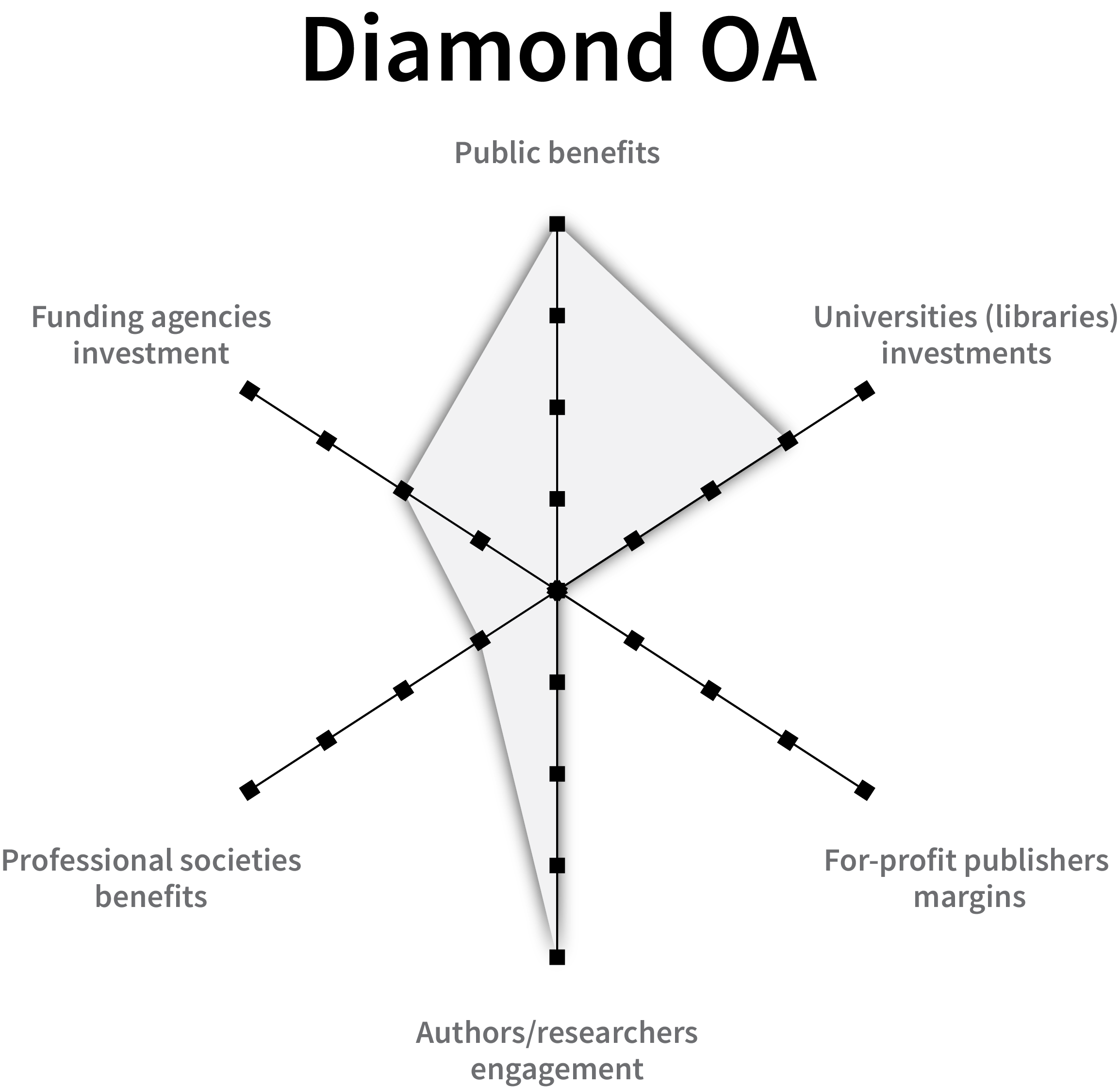
Figure 2. Estimated relative contributions of key stakeholders across current scholarly publishing models. Values range from minimal (centre of the spider chart) to maximal (outer edge). Paywalled systems require substantial subscription fees from university libraries and other sources, generating high profit margins for commercial publishers and for societies that grew under this model. Green OA increases public benefit by making research outputs partly available (typically the Author Accepted Manuscript and after an embargo period), but it does not substantially change the distribution of profits: funders increase investment to support repositories, and subsidised researchers must self-archive and ensure compliance with open access and formatting requirements. Gold OA shifts the cost burden from libraries to authors (partly mitigated by transformative Read & Publish agreements and funder deals): APCs must be built into grants, private-publisher profits rise, and societies lose subscription-based income. Diamond OA moves away from for-profit publishing houses and relies upon public, non-profit infrastructure, reducing funds previously funnelled into private profit. Public benefit is maximised, as no taxpayer funds are diverted to for-profit entities, and authors and scholarly communities invest more effort into governance and editorial work for the collective good. Societies, though losing profit margins, may gain renewed academic engagement and help build new membership and supporter networks.
3.2. Long-term drawbacks
In a world that is aiming (overall) to shift towards OA, continuing to publish research in for-profit journals behind paywalls, while uploading AAMs to repositories for compliance with funding agencies through the Green OA route, is ultimately counterproductive. This practice hinders meaningful change in the way science is published. By maintaining this model, the academic community implicitly accepts that billions of dollars of potential research funding will continue to flow into the profits of private publishing companies rather than supporting scientific work ([19]). It becomes evident why the Green OA has been widely favoured: it reinforces the existing for-profit publishing system, preserves the prestige tied to impact factors and journal branding, and requires relatively little effort from most stakeholders.
While Green OA claims to deliver the same result (i.e., public access to research) it does so without challenging the structures that underpin the current academic publishing economy. Of course, publishing involves legitimate costs such as copyediting and typesetting, which must be covered. However, it is crucial to remember that peer reviewers, authors, and many editors contribute their labour for free, while publishers still generate significant profits from their work ([19]; [20]). Because many researchers are reluctant to change their publishing habits, and because newer Diamond OA journals (discussed below) often lack an established impact factor, they continue to support a deeply flawed and unsustainable system rather than embracing alternatives that could truly transform scholarly publication.
4. Diamond OA: a sustainable future for publishing science
In response to the growing profits generated at the expense of researchers and public funds, several scientific communities have launched community-led Diamond OA journals to reclaim control of scholarly publishing from commercial interests. While Diamond OA options had existed for some time (e.g., Rivista Italiana di Paleontologia e Stratigrafia), and were quite dominant in other scientific fields, in the geosciences, this movement was rejuvenated with Volcanica ([4]) and was soon followed by Tektonika ([21]), Seismica ([22]), Sedimentologika ([23]), Geomorphica ([24]), Advances in Geochemistry and Cosmochemistry ([25]), Open Palaeontology ([26]), Geodynamica, jSEDI, and Planetary Research. All of these journals are hosted by university libraries or other non-profit institutions and most use the free, open-source platform Open Journal Systems (OJS; pkp.sfu.ca/software/ojs), developed by the Public Knowledge Project (PKP; pkp.sfu.ca). Two exceptions are Geodynamica, which runs on Janeway (janeway.systems), and jSEDI, which is hosted on Episciences (episciences.org). OJS allows for managing submissions, editorial workflow and subsequent publication ([23], prefix=see ). Alternatively, some established journals have flipped their publishing model ([27]), leaving commercial publishers to operate under community or university presses. For instance, Lethaia transitioned from Wiley to the Scandinavian University Press ([28]). In all these cases, articles are free to read, no APCs are charged and authors are free to distribute the VoR of their article ().
In this model, funding bodies and university libraries redirect portions of their budgets traditionally allocated to subscriptions and APCs to subsidise not-for-profit publishing venues. Within these academic publishing houses, professional staff provide both material and in-kind services, enabling scholars to operate journals at little-to-no cost. This approach results in a system where publishing and access are both free, and authors can freely share their work. Research is disseminated in its final formatted version (the VoR), with comparable quality to that of commercial publishers. Crucially, since no profit is involved, the legitimacy of these journals rests on their reputation. This can foster greater scrutiny in the editorial process and, ideally, a stronger and more motivated involvement of editors and reviewers whose labour is no longer appropriated for commercial gain.
Copy-editing and formatting can be carried out in various ways, either by volunteers running the journal (often academics themselves) or by subsidised professionals, depending on the journal’s funding model. Although this approach may require more work from academics, it stands in stark contrast to the exploitative nature of the current Gold OA system. In that context, such efforts may be considered a necessary step toward establishing a more equitable model of scholarly communication. This opinion piece advocates precisely for that shift.
One of the main obstacles to adopting these new models lies in academic culture itself. Many researchers, particularly senior academics, still respond to new Diamond OA journals with one question: “What is the impact factor?”. Because most of these journals are recent, they either do not yet have an impact factor or deliberately choose not to participate in this system, given that journal impact factors are widely recognised as flawed and biased metrics ([29]; [30], prefix=e.g., ). Yet the impact factor continues to dominate perceptions of journal prestige and is misused in researcher evaluation. Originally, the impact factor was developed to help librarians decide which journals to purchase, but it has unfortunately become a proxy for evaluating researchers. To counter this misuse, 26774 individuals and organisations across 171 countries have now signed the San Francisco Declaration on Research Assessment (DORA) (sfdora.org/read; consulted on January 19, 2026), advocating for an evaluation system that eliminates journal-based metrics. Adopting DORA implies recognising that peer-reviewed scholarly publications are valid scientific contributions regardless of the journal’s impact factor. In theory, this principle should put Diamond OA journals on an equal footing with their commercial counterparts.
Currently, many countries career evaluation systems still use impact factors as necessary metrics, preventing widespread use of journals that do not provide such metrics. Additionally, many (particularly senior) researchers, who are often the ones responsible for evaluating others, continue to rely on numerical metrics rather than assessing the scientific merit and impact of research, especially when it falls outside their field. These persistent dependences on outdated measures remain one of the greatest barriers to achieving a fair and sustainable publishing system. Pushing reform in researcher assessment, the Stockholm Declaration ([31]), which endorses DORA, was recently published and emphasises that (i) academia should take back control of publishing; (ii) quality should be valued over quantity, and metrics should not be used as proxies for excellence; (iii) tools should be developed and used to detect and track fraudulent publications; and (iv) policies should be implemented to increase the quality and integrity of scientific publications. These four pillars of the Stockholm Declaration are readily implementable through community-led Diamond OA journals, which are run by scientists for scientists and operate on a not-for-profit basis.
Another common concern about Diamond OA journals is their long-term sustainability and the preservation of published papers. A frequent question that is fielded to these journals is: “What happens if the journal stops?”. The usual response is: “and what happens if Elsevier shuts down?”. In reality, nothing lasts forever—except diamonds. While large, well-established commercial publishers may seem too big to fail, academia and society takes their permanence for granted, but the future is never certain. It has happened in the past that journals and even publishers were obliged to shut down, or be abandoned ([32], prefix=see for example the case of Hindawi; ). Fortunately, Diamond OA journals using platforms like OJS, have robust digital preservation strategies. For example, the PKP Preservation Network (PKP PN) plugin leverages the LOCKSS program (Lots of Copies Keep Stuff Safe; lockss.org), which ensures multiple copies of content are securely stored across a geographically distributed, decentralised network of servers that are maintained by libraries. In this sense, an institutionally backed, internationally replicated and standardised open system offers one of the most sustainable approaches to long-term preservation.
Because community-driven Diamond OA journals require only modest (and transparent) funding to operate, they offer a genuinely sustainable, accessible, and equitable alternative for scientific publishing. For example, Sedimentologika operates at approximately US$2500 per year (including Crossref indexing, hosting, and in-kind support from the Open Access Publications team at the University of Geneva, Switzerland), roughly equivalent to a single average APC.
Redirecting the substantial financial support currently granted to commercial publishing houses—whose credibility has been steadily eroding for years ([33]; [34]; [35])—towards a coordinated effort to re-empower academics in their own publication ecosystem is both feasible and necessary. In an equitable system, publicly funded research should be accessible to all at every stage of the research cycle, from submission to dissemination. While the OA movement has undoubtedly transformed scholarly communication, its ultimate goal remains unfulfilled: under the current oligopolistic landscape dominated by Gold OA, neither fair costs nor universal dissemination have been fully realised ([36]; [37]). Within this context, Green OA plays a complex role. While its purpose is to make knowledge widely available, in disciplines and countries where OA has become mandatory, it often serves primarily to uphold legacy structures, thereby delaying any meaningful transition toward a more sustainable publishing model.
Therefore, we urge researchers to invest in their Diamond OA ecosystems, as authors, reviewers, editors and supporters, while limiting support to for profit publishing venues. The wider adoption of the Diamond OA system is firmly in our hands ([38]; [36]) and public stakeholders in European countries ([39]; [40]) or Canada ([41]), for example, have prepared infrastructures and regulations for such transformation. We also urge academic societies to seize this opportunity to anchor themselves as supporters of this transition. While they may lose some direct income by moving away from subscription-based and APC-driven models, they can become key actors of this transformation, by providing support, expertise and guidance through their experience and networks. Similarly, scholars should support their network by subscribing to their professional societies, wherever possible.
Downloads
References
Anderson, R. (2023). The American Chemical Society Offers a New Twist on the Article Processing Charge: An Interview with Sarah Tegen. https://scholarlykitchen.sspnet.org/2023/10/02/the-american-chemical-society-offers-a-new-twist-on-the-article-processing-charge-an-interview-with-sarah-tegen/
Andringa, S., Mos, M., Van Beuningen, C., González, P., Hornikx, J., & Steinkrauss, R. (2024). Diamond is a scientist’s best friend. Dutch Journal of Applied Linguistics, 13. https://doi.org/10.51751/dujal18802 DOI: https://doi.org/10.51751/dujal18802
Arasteh-Roodsary, S. L., Gaillard, V., Garbuglia, F., Mounier, P., Pölönen, J., Proudman, V., Rooryck, J., Saenen, B., & Stone, G. (2025). Diamond open access recommendations and guidelines for institutions, funders, sponsors, donors, and policymakers. Zenodo. https://doi.org/10.5281/zenodo.15518745
Asai, S. (2021). Author Choice of Journal Type Based on Income Level of Country. Journal of Scholarly Publishing, 53(1), 24–34. https://doi.org/10.3138/jsp.53.1.03 DOI: https://doi.org/10.3138/jsp.53.1.03
Beigel, F., Brockington, D., Crosetto, P., Derrick, G., Fyfe, A., Barreiro, P. G., Hanson, M. A., Haustein, S., Larivière, V., & Noe, C. (2025). The Drain of Scientific Publishing. arXiv. https://doi.org/10.48550/arXiv.2511.04820
Butcher, J. (2025). The rise of China and the fall of open access. https://newsletter.journalology.com/p/the-rise-of-china-and-the-fall-of
Butler, L.-A., Matthias, L., Simard, M.-A., Mongeon, P., & Haustein, S. (2023). The oligopoly’s shift to open access: How the big five academic publishers profit from article processing charges. Quantitative Science Studies, 4(4), 778–799. https://doi.org/10.1162/qss_a_00272 DOI: https://doi.org/10.1162/qss_a_00272
Constantin, M., de Leeuwe, J., van Rijn, S., Saive, M., Tarchi, A., & de Vries, H. (2025). How to flip your journal: A guide to more equitable publishing with Diamond Open Access. Zenodo. https://doi.org/10.5281/zenodo.14652446
Dimitrov, J. D., Kaveri, S. V., & Bayry, J. (2010). Metrics: Journal’s impact factor skewed by a single paper. Nature, 466(7303), 179–179. https://doi.org/10.1038/466179b DOI: https://doi.org/10.1038/466179b
Doyle, P., Ebbestad, J. O. R., Lindskog, A., Lindemann, F.-J., Mángano, G., & Stouge, S. (2022). Lethaia Editorial Briefing. Lethaia, 55(1), 1–1. https://doi.org/10.18261/let.55.1.0 DOI: https://doi.org/10.18261/let.55.1.0
Drage, H. B., Keating, J. N., Nielsen, M. L., Saleh, F., & Wong Hearing, T. W. (2025). Open Palaeontology: A new model of diamond open access journal for palaeontology. OPEN Palaeontology, 1(1). https://doi.org/10.26034/la.opal.2024.6223 DOI: https://doi.org/10.26034/la.opal.2024.6223
Dulong de Rosnay, M. (2021). Open Access Models, Pirate Libraries and Advocacy Repertoires: Policy Options for Academics to Construct and Govern Knowledge Commons. Westminster Papers in Communication and Culture, 16(1). https://doi.org/10.16997/wpcc.913 DOI: https://doi.org/10.16997/wpcc.913
Dwianto, A. (2025). Ahead of Profit Theory: Academic Publishing Running Faster than Science… Seriously? Ssrn. https://doi.org/10.2139/ssrn.5417957 DOI: https://doi.org/10.2139/ssrn.5417957
Farquharson, J. I., & Wadsworth, F. B. (2018). Introducing Volcanica: The first diamond open-access journal for volcanology. Volcanica, 1(1), i–ix. https://doi.org/10.30909/vol.01.01.i-ix DOI: https://doi.org/10.30909/vol.01.01.i-ix
Fernandez-Blanco, D., Lacassin, R., Gouiza, M., Perez-Diaz, L., Magee, C., McCarthy, D., Doré, T., Péron-Pinvidic, G., Kavanagh, J., Bond, C., & Schmitt, R. (2023). Tektonika: The Community-Led Diamond Open-Access Journal for Tectonics and Structural Geology. Tektonika, 1(2). https://doi.org/10.55575/tektonika2023.1.1.56 DOI: https://doi.org/10.55575/tektonika2023.1.1.56
Frank, J., Foster, R., & Pagliari, C. (2023). Open access publishing—Noble intention, flawed reality. Soc Sci Med, 317, 115592. https://doi.org/10.1016/j.socscimed.2022.115592 DOI: https://doi.org/10.1016/j.socscimed.2022.115592
Hagve, M. (2020). The money behind academic publishing. https://tidsskriftet.no/en/2020/08/kronikk/money-behind-academic-publishing
Hahn, D., Hehn, J., Hopp, C., & Pruschak, G. (2023). Mapping the Swiss Landscape of Diamond Open Access Journals. The PLATO Study on Scholar-Led Publishing. Zenodo. https://doi.org/10.5281/zenodo.7461728
Haustein, S., Schares, E., Alperin, J. P., Hare, M., Butler, L.-A., & Schönfelder, N. (2024). Estimating global article processing charges paid to six publishers for open access between 2019 and 2023. arXiv Preprint. https://doi.org/10.48550/arXiv.2407.16551
Heen, E., & Vogt, H. (2024). Scientific rot: Unsustainable publishing practices threatens trust in medicine. J Eval Clin Pract, 30(6), 941–944. https://doi.org/10.1111/jep.13989 DOI: https://doi.org/10.1111/jep.13989
Huang, C.-K., Neylon, C., Montgomery, L., Hosking, R., Diprose, J. P., Handcock, R. N., & Wilson, K. (2024). Open access research outputs receive more diverse citations. Scientometrics, 129(2), 825–845. https://doi.org/10.1007/s11192-023-04894-0 DOI: https://doi.org/10.1007/s11192-023-04894-0
Johnson, R., Pinfield, S., & Fosci, M. (2016). Business process costs of implementing “gold” and “green” open access in institutional and national contexts. Journal of the Association for Information Science and Technology, 67(9), 2283–2295. https://doi.org/10.1002/asi.23545 DOI: https://doi.org/10.1002/asi.23545
Kincaid, E. (2023). Wiley to stop using “Hindawi” name amid $18 million revenue decline. https://retractionwatch.com/2023/12/06/wiley-to-stop-using-hindawi-name-amid-18-million-revenue-decline/
Klebel, T., Traag, V., Grypari, I., Stoy, L., & Ross-Hellauer, T. (2025). The academic impact of Open Science: A scoping review. Royal Society Open Science, 12(3), 241248. https://doi.org/10.1098/rsos.241248 DOI: https://doi.org/10.1098/rsos.241248
Lefebvre, A., Bosch, R., Burrows, K., Giaime, M., Goodwin, G., Lai, L. S.-H., Stammler, M., & Fernández, R. (2025). Geomorphica: The most accessible journal for the geomorphology community. Geomorphica, 1(1). https://doi.org/10.59236/geomorphica.v1i1.54 DOI: https://doi.org/10.59236/geomorphica.v1i1.54
Ma, L., Buggle, J., & O’Neill, M. (2023). Open access at a crossroads: Library publishing and bibliodiversity. Insights the UKSG Journal, 36. https://doi.org/10.1629/uksg.613 DOI: https://doi.org/10.1629/uksg.613
Mamtora, J., Bradshaw, W., & Lemberget, T. (2025). Unlocking the repository: A strategy for increasing the uptake of green open access. IFLA Journal. https://doi.org/10.1177/03400352251364821 DOI: https://doi.org/10.1177/03400352251364821
Morrison, H., Borges, L., Zhao, X., Kakou, T. L., & Shanbhoug, A. N. (2022). Change and growth in open access journal publishing and charging trends 2011–2021. Journal of the Association for Information Science and Technology, 73(12), 1793–1805. https://doi.org/10.1002/asi.24717 DOI: https://doi.org/10.1002/asi.24717
Pourret, O., Millet, M.-A., Marin-Carbonne, J., Mallik, A., Tierney, J. E., Darling, J. R., Kiseeva, E. S., Torres, M. A., Fonseca, R. O. C., Tartèse, R., Namur, O., Klöcking, M., Matthews, S. W., Dahrén, B., Ickert, R. B., & The inaugural, A. G. C. editorial board. (2025). Equitable Access, Open Science, and the Future of Publishing in Geochemistry and Cosmochemistry. Advances in Geochemistry and Cosmochemistry, 1(1). https://doi.org/10.33063/agc.v1i1.770 DOI: https://doi.org/10.33063/agc.v1i1.770
Rothfritz, L., Schmal, W. B., & Herb, U. (2024). Trapped in transformative agreements? A multifaceted analysis of> 1,000 contracts. arXiv. https://doi.org/10.48550/arXiv.2409.20224 DOI: https://doi.org/10.59350/n40cd-5wc63
Rowe, C., Agius, M., Convers, J., Funning, G., Galasso, C., Hicks, S., Huynh, T., Lange, J., Lecocq, T., Mark, H., Ragon, T., Rychert, C., Teplitzky, S., Van den Ende, M., & Okuwaki, R. (2022). The launch of Seismica: A seismic shift in publishing. Seismica, 1(1). https://doi.org/10.26443/seismica.v1i1.255 DOI: https://doi.org/10.26443/seismica.v1i1.255
Sabel, B., & Larhammar, D. (2025). Reformation of science publishing: The Stockholm Declaration. Royal Society Open Science, 12(11), 251805. https://doi.org/10.1098/rsos.251805 DOI: https://doi.org/10.1098/rsos.251805
Shu, F., & Larivière, V. (2024). The oligopoly of open access publishing. Scientometrics, 129(1), 519–536. https://doi.org/10.1007/s11192-023-04876-2 DOI: https://doi.org/10.1007/s11192-023-04876-2
Šimukovič, E. (2024). Transformative Agreements Are a Blind Alley. Katina. https://doi.org/10.1146/katina-20241008-1 DOI: https://doi.org/10.1146/katina-20241008-1
Swartz, A. (2011). Guerilla Open Access Manifesto. https://archive.org/details/GuerillaOpenAccessManifesto
Thomas, C., Privat, A., Vaucher, R., Spychala, Y., Zuchuat, V., Marchegiano, M., Poyatos-Moré, M., Kane, I., & Chiarella, D. (2023). Sedimentologika: A community-driven diamond open access journal in sedimentology. Sedimentologika, 1(1). https://doi.org/10.57035/journals/sdk.2023.e11.1015 DOI: https://doi.org/10.57035/journals/sdk.2023.e11.1015
Tsakonas, G., Zoutsou, K., & Perivolari, M. (2023). Secondary Publishing Rights in Europe: Status, challenges & opportunities. Zenodo. https://doi.org/10.5281/zenodo.8428315
UNESCO. (2021). Recommendation on Open Science. https://doi.org/10.54677/MNMH8546 DOI: https://doi.org/10.54677/MNMH8546
van Bellen, S., & Céspedes, L. (2025). Diamond open access and open infrastructures have shaped the Canadian scholarly journal landscape since the start of the digital era. The Canadian Journal of Information and Library Science / La Revue Canadienne Des Sciences De L’information Et De Bibliothéconomie, 48(1), 96–111. https://doi.org/10.5206/cjils-rcsib.v48i1.22207 DOI: https://doi.org/10.5206/cjils-rcsib.v48i1.22207
Vanclay, J. K. (2009). Bias in the journal impact factor. Scientometrics, 78(1), 3–12. https://doi.org/10.1007/s11192-008-1778-4 DOI: https://doi.org/10.1007/s11192-008-1778-4
Walter, P., & Mullins, D. (2019). From symbiont to parasite: The evolution of for-profit science publishing. Molecular Biology of the Cell, 30(20), 2537–2542. https://doi.org/10.1091/mbc.E19-03-0147 DOI: https://doi.org/10.1091/mbc.E19-03-0147
Downloads
Additional Files
License
Copyright (c) 2026 Romain Vaucher, Camille Thomas

This work is licensed under a Creative Commons Attribution 4.0 International License.